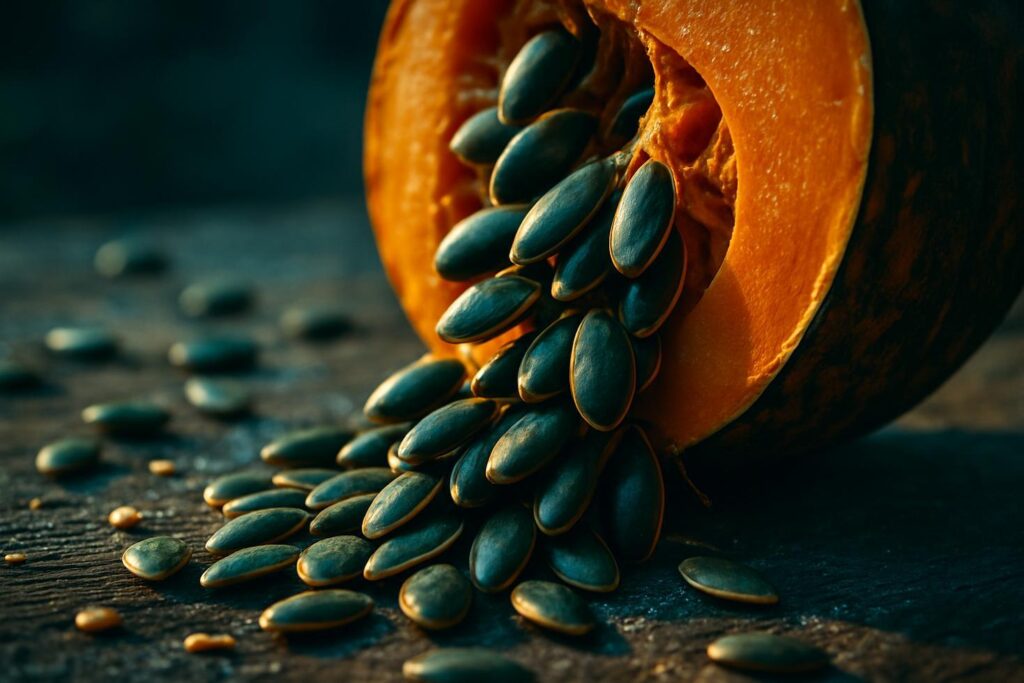
One ounce of pumpkin seeds delivers 2.2 mg of zinc — roughly 20% of a man’s daily requirement — and when researchers restricted healthy men to a low-zinc diet for 20 weeks, testosterone fell from approximately 40 nmol/L to 10.6 nmol/L.
Zinc is a structural component in the enzyme machinery the body uses to synthesize testosterone — not a catalyst, not a cofactor, but a required building block. That biochemical fact makes the zinc content of pumpkin seeds genuinely interesting. One small handful sits at the intersection of plant survival strategy and human endocrine biology.
Pumpkin seeds concentrate their zinc inside the seed coat. The plant stores it there as a resource for germination — a sealed reserve meant to carry a future seedling through dormancy and drought. That same concentration is what makes the seed nutritionally useful to something other than a Cucurbita plant.
How Zinc Restriction Affects Testosterone Levels in Men
The 20-week study published in Nutrition (1996) remains the clearest human evidence. Healthy men eating a low-zinc diet saw testosterone drop from approximately 40 nmol/L to 10.6 nmol/L — a decline of nearly 75%. The men weren’t ill. They weren’t elderly. The variable was zinc intake alone.
The same research tracked the reverse: marginally deficient older men given zinc supplements for six months saw testosterone climb from 8.3 to 16.0 nmol/L. Zinc deficiency’s effect on testosterone is reversible — the machinery restarts when the material returns.
What Pumpkin Seed Zinc Content Actually Means Proportionally
At 2.2 mg per ounce, pumpkin seeds are a solid plant-based zinc source. They are not, however, the richest zinc food available. Oysters deliver roughly 20–25 mg of zinc per ounce depending on species and preparation — an order of magnitude higher.
What pumpkin seeds offer is consistent, accessible zinc from a plant source alongside magnesium and other minerals. A mouse-model study found that pumpkin seed extract produced testosterone levels of 5.573 ng/mL compared to 0.837 ng/mL in the control group. Rodent models don’t translate directly to human outcomes, but the directional signal is consistent with the zinc mechanism.
Closing
The zinc inside a pumpkin seed was stored there for a plant, not a person. The seed has no interest in human endocrine function. But the concentration it built for its own survival happens to map onto a real gap in human nutrition, and the biochemistry connecting zinc to testosterone is not speculative — it shows up in measurable numbers across multiple study designs.
A seed that outlasted a winter underground. A hormone that depends on the same mineral. The overlap is accidental. The mechanism is not.
Frequently Asked Questions
How much zinc is in pumpkin seeds per ounce?
One ounce (28 g) of hulled pumpkin seeds contains approximately 2.2 mg of zinc, equal to about 20% of the US daily value for adult men.
Can eating pumpkin seeds raise testosterone?
There is no direct human clinical trial showing pumpkin seeds raise testosterone. The connection runs through zinc: correcting zinc deficiency raises testosterone, and pumpkin seeds supply zinc.
How fast does zinc deficiency lower testosterone?
In a 1996 study, healthy men on a low-zinc diet showed testosterone drop from roughly 40 nmol/L to 10.6 nmol/L over approximately 20 weeks.
Does zinc supplementation actually increase testosterone?
In marginally zinc-deficient older men, six months of zinc supplementation raised testosterone from 8.3 to 16.0 nmol/L, according to the same Nutrition 1996 research.