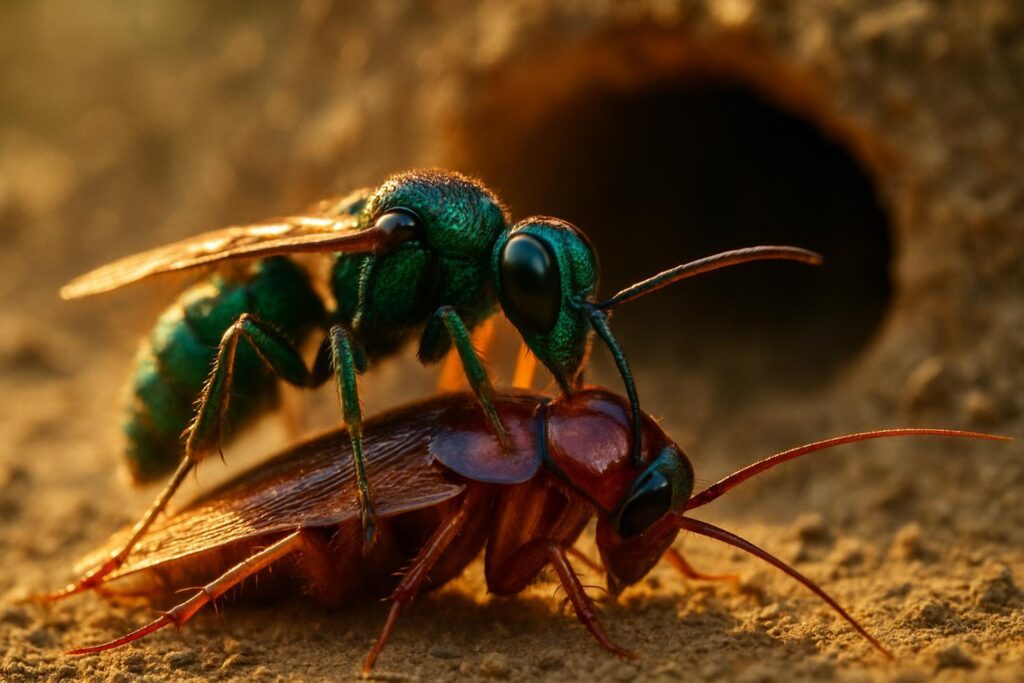
Two stings. One suppresses escape circuitry. The cockroach walks itself into a burrow on its own legs — a living host for up to 7 days.
The emerald jewel wasp (Ampulex compressa) does not paralyze cockroaches. It delivers two precisely placed stings that suppress the cockroach’s escape motivation while leaving its legs fully operational. That distinction — between unable to move and unwilling to move — is what makes the behavior so remarkable to neurobiologists.
The first sting hits the thoracic ganglia, briefly disabling the front legs for roughly 1–5 minutes. That window is enough to hold the cockroach still for what comes next.
What the Second Sting Actually Does to the Cockroach’s Brain
The second sting is the defining event. The wasp drives its stinger into the head ganglia — studies describe targets including the subesophageal ganglion, the supraesophageal ganglion, and structures in the central complex, depending on the research. The venom alters neuronal activity in those specific regions rather than broadly poisoning the host.
The result is hypokinesia: a dramatic reduction in spontaneous escape-seeking behavior. The cockroach stops initiating flight responses. It can still right itself if flipped over. Its walking pattern generator remains functional. It simply shows no drive to flee.
Research suggests the wasp uses sensory input from the stinger itself to distinguish brain tissue from surrounding tissue, enabling placement into the target region.
How the Cockroach’s Behavior Changes After Stinging
After the head sting, the cockroach enters a grooming phase that lasts roughly 30 minutes. Then the docile state sets in — typically around 30–40 minutes post-sting.
The wasp, meanwhile, leaves for approximately 30 minutes before returning. When it comes back, it guides the cockroach by the antenna into a prepared burrow. The cockroach walks there on its own legs. The wasp lays a single egg on the roach’s leg, then seals the burrow entrance with pebbles, stones, or plant debris.
The cockroach remains alive and compliant inside. The larva that hatches feeds on the living host, keeping it viable throughout development. That docile state holds for several days — up to approximately 7 days in cases where the roach is not consumed.
Frequently Asked Questions
What exactly does the jewel wasp sting do to a cockroach?
The first sting temporarily paralyzes the front legs for 1–5 minutes. The second sting suppresses escape-related neural circuits in the head ganglia, producing a lasting state of reduced motivation to flee while leaving other motor functions intact.
Can the cockroach still move after being stung by a jewel wasp?
Yes. The cockroach retains its walking pattern generator and can right itself and, when startled, may jump — but it does not initiate escape or flee the wasp.
How long does the jewel wasp’s behavioral effect last?
The docile state begins around 30–40 minutes after stinging and can last several days, with some accounts reporting up to approximately 7 days.
Where does the jewel wasp lay its egg?
The wasp lays a single egg on the cockroach’s leg after guiding it into a burrow, which the wasp then seals.