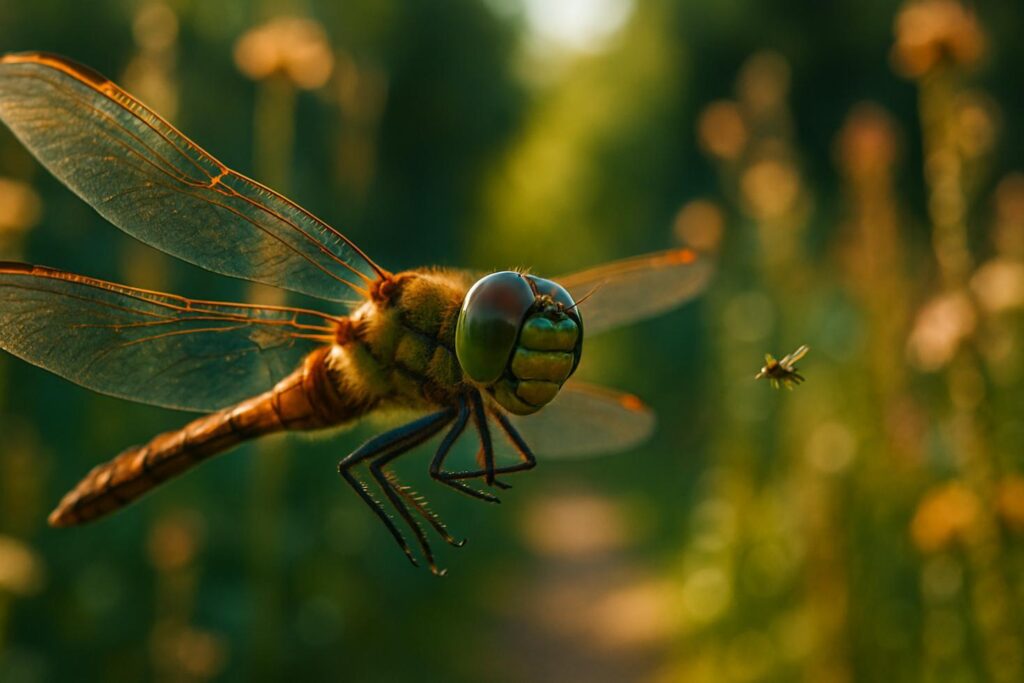
Dragonflies fly 1 m/s faster than their target — not by reacting, but by flying straight to where the prey will be. Without open sky, none of it works.
Dragonflies intercept prey rather than chase it, flying directly to a predicted point in space while maintaining a constant speed advantage of about 1 meter per second over their target. That distinction — intercept versus chase — changes everything about how this animal hunts. It is less like a sprinter and more like a fielder who reads the ball before it lands.
The geometry starts with vision. Dragonflies keep prey locked inside a roughly 50-degree cone directly overhead, reducing the pursuit to a simpler vertical-tracking problem while the body aligns toward the target.
How the Dragonfly’s Interception Geometry Actually Works
UC Davis researchers presented dragonflies with moving targets and found the speed advantage stayed near 1 meter per second no matter how fast the target moved. That consistency points to a pursuit rule, not a case-by-case calculation adjusted mid-flight.
The overhead visual cone does specific mechanical work. By tracking in the vertical direction at the zenith, the dragonfly simplifies a three-dimensional chase into a two-dimensional alignment problem. Body orientation and wing adjustment follow from that locked angle.
Why Garden Structure Determines Whether the Hunt Happens at All
The visual and mechanical system is effective only when the physical environment supports it. Dense canopy, disrupted airflow, and closed sightlines all interfere with prey detection and approach geometry before a pursuit can begin.
A garden with open mid-level airspace gives dragonflies the flight corridors their interception strategy requires. The bottleneck is structural, not physiological — the dragonfly’s reaction speed is not the limiting factor; the available geometry is. Any microclimate change that shifts vegetation structure, light penetration, or prey flight paths will affect hunting conditions more directly than it affects the dragonfly itself.
Empty air between plants is not neutral space. It is the medium the hunt runs through.
Frequently Asked Questions
How fast do dragonflies fly compared to their prey?
Experimental evidence from UC Davis shows dragonflies fly at approximately 1 meter per second faster than their target, holding that gap regardless of how fast the prey is moving.
What is the dragonfly’s visual cone during prey capture?
During pursuit, dragonflies keep prey within a roughly 50-degree cone directly overhead, using that angle to simplify tracking and align body position toward the intercept point.
Why do dragonflies need open flight corridors to hunt?
Their interception strategy depends on unobstructed sightlines and room to fly a straight predicted path. Dense vegetation or disrupted airspace prevents the pursuit from starting.
What limits dragonfly hunting success in a garden — speed or space?
Research indicates the limiting factor is flight-space structure — open corridors, light, and prey visibility — rather than the dragonfly’s reaction time or speed.