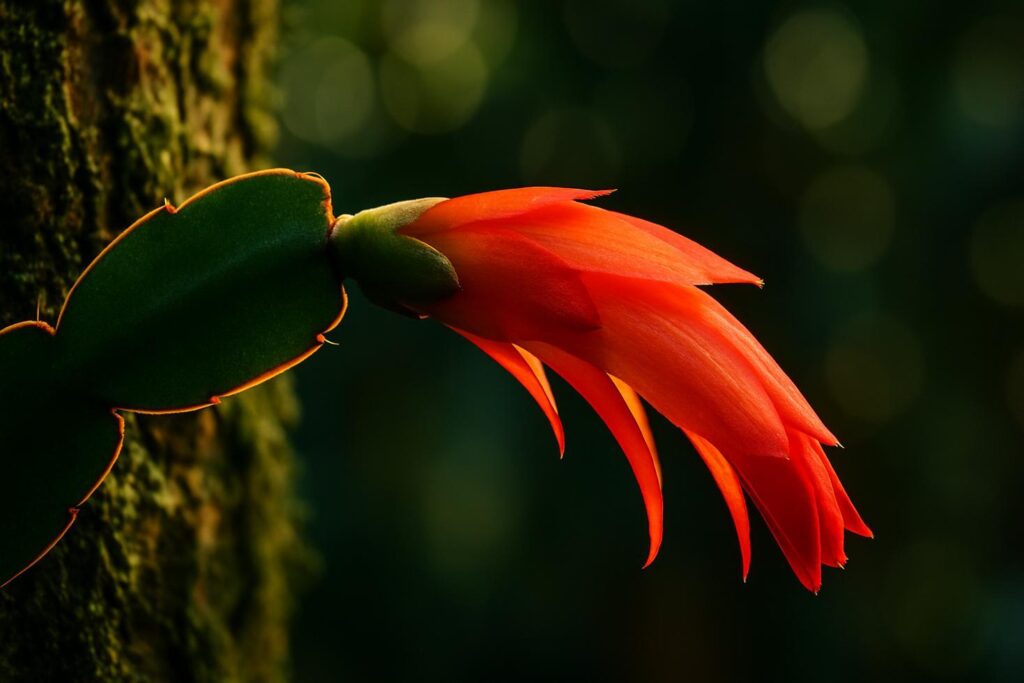
A Christmas cactus starts its flowering countdown in September — measuring 12–14 hours of uninterrupted darkness each night for 6–8 weeks. One light interruption mid-night doesn’t pause that signal. It disrupts it.
A Christmas cactus doesn’t track the calendar — it measures night length. Phytochrome proteins in its cells shift state during darkness, and this cumulative signal is what eventually triggers a switch from vegetative growth to flower bud formation.
That mechanism traces back to the plant’s origins. Christmas cactus (Schlumbergera species) grows wild as an epiphyte in the humid, shaded forests of Brazil, where seasonal shifts in night length reliably signal the right time to flower. The windowsill version inherited that same biological clock.
The Night-Length Requirement That Triggers Blooming
Bud formation requires 12–14 hours of uninterrupted darkness each night, sustained across roughly 6–8 weeks before the target bloom window. Colorado State University recommends starting the conditioning period around September 19, pairing long dark periods with cool nights near 60°F and limiting daytime light to about 9 hours.
Night temperature matters alongside darkness. Most sources recommend keeping nights between 50–65°F during the conditioning period, with daytime temperatures below 70°F. Cool nights and long darkness appear to work together to push the plant into floral induction.
Why a Single Light Interruption Can Disrupt the Signal
The phytochrome system underlying this process is sensitive to light during the dark period. Horticulture sources consistently warn that hallway light, streetlamps, or even briefly opening a closet door during the dark period can interfere with bud induction.
This happens because Christmas cactus is a short-day plant — meaning it’s actually responding to night length, not day length. The plant uses the unbroken stretch of darkness as its cue. Interrupting darkness mid-night disrupts that cue, which is why practical advice recommends a completely lightproof location, like a dark closet or a box, rather than simply a dim room.
What Blooming Actually Looks Like After Conditioning
After 6–8 weeks of proper dark and cool treatment, buds form and the flowering period typically runs 4–6 weeks, with individual flowers lasting roughly 5–7 days each, though some sources report 6–9 days depending on temperature. The overall bloom window usually falls between late November and early January.
The plant doesn’t reward warmth or extra light during this stage. Blooming is the product of weeks of managed darkness, not of anything added once buds appear.
The Christmas cactus is operating on a system its ancestors refined in Brazilian forest canopies, where night length was a more reliable seasonal signal than temperature alone. That system is still running, in exactly the same way, on kitchen windowsills everywhere.
It was never counting days. It was measuring nights.
Frequently Asked Questions
How many hours of darkness does a Christmas cactus need to bloom?
12–14 hours of complete, uninterrupted darkness each night, maintained for approximately 6–8 weeks before the desired bloom period.
What temperature does a Christmas cactus need during the dark period?
Night temperatures between 50–65°F, paired with daytime temperatures below 70°F, are the most commonly recommended range during the conditioning period.
Does a quick light exposure really disrupt bud formation?
Yes, according to multiple horticulture sources. Light during the dark period can interfere with photoperiod signaling, which is why a lightproof space is recommended rather than simply a dim one.
When should Christmas cactus dark conditioning begin?
Colorado State University recommends starting around September 19 for Christmas blooms; other sources suggest early to mid-October as an acceptable starting window.
Sources:
Colorado State University
Good Housekeeping
Gardening Know How
Ambius
Planet Desert