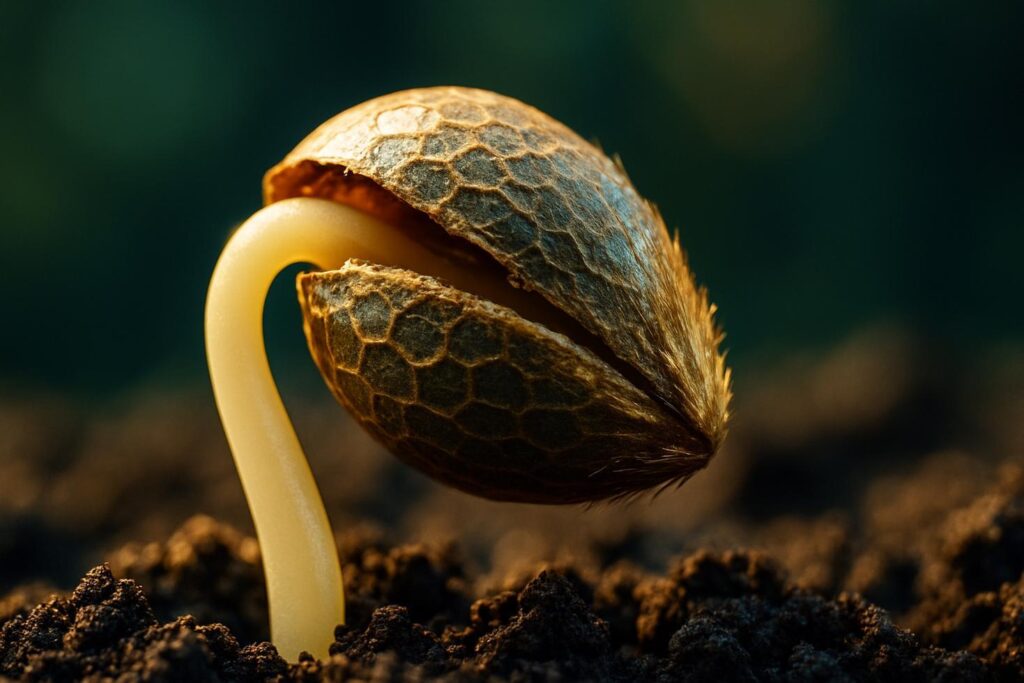
A light flash lasting mere seconds during tillage flips a dormancy switch in small-seeded broadleaf weeds — tilling in darkness cuts their emergence by 50–80%.
Many buried weed seeds don’t respond to warmth or rain. They respond to light — specifically, the brief flash they receive when soil is disturbed during tillage. That single flash, processed through a protein called phytochrome, is enough to break dormancy in species like lambsquarters, pigweed, and wild mustard.
The mechanism is well-documented. As a tractor turns soil in daylight, seeds buried in the upper 0–30 mm get a split-second exposure to red and white light before being reburied. For these photoblastic seeds, that moment is the starting signal.
How Phytochrome Controls Weed Seed Dormancy
Weed seeds buried in the soil gradually develop a heightened sensitivity to light. Phytochrome exists in two interconvertible forms. A red-light flash shifts it toward the active form, and that shift can exit the seed from dormancy through what researchers call low fluence response pathways.
Photosensitivity can shift across nine orders of magnitude within a single week. This means the seed bank is not static — sensitivity fluctuates based on burial conditions and season.
Even ambient light matters for the most sensitized seeds. One review notes that seconds of full moonlight, or minutes under starlight, could photostimulate highly sensitive seeds. The tillage flash during daytime, however, remains the primary triggering event documented across field experiments.
Night Tillage Results and Their Limits
USDA-ARS summarizes reductions of 50–80% in small-seeded broadleaf species from darkness tillage. That list includes common lambsquarters, pigweed, common ragweed, black nightshade, smartweed, and wild mustard. Velvetleaf, cocklebur, and annual grasses showed no reduction.
The benefit is real but not universal. A 2015 review of field experiments from 1990 to 2004 found that delayed soil drying overnight may favor germination in some conditions, producing a few cases where night-tilled plots had higher weed density. Soil moisture in the upper emergence zone, species composition, and timing all interact with the light-suppression effect.
WSU extension trials reported an average of 37% fewer weeds in night-tilled plots — a more conservative figure than the USDA-ARS ceiling, and a useful baseline for mixed-species fields.
Frequently Asked Questions
Why does tillage trigger germination when burial alone doesn’t?
Burial causes seeds to develop light sensitivity over time; the tillage flash then provides the red-light signal that phytochrome needs to exit dormancy.
Which weeds are reduced by night tillage?
Small-seeded broadleaf species — lambsquarters, pigweed, wild mustard, smartweed, ragweed — show 50–80% reductions. Grasses and large-seeded weeds like velvetleaf are unaffected.
Does night tillage hurt crop yields?
WSU trials found no significant grain yield difference between daytime and nighttime tillage treatments.
Is moonlight enough to trigger weed seeds during night tillage?
Extremely light-sensitized seeds can respond to seconds of full moonlight, according to one review, though the tillage flash during daylight remains the primary documented trigger.