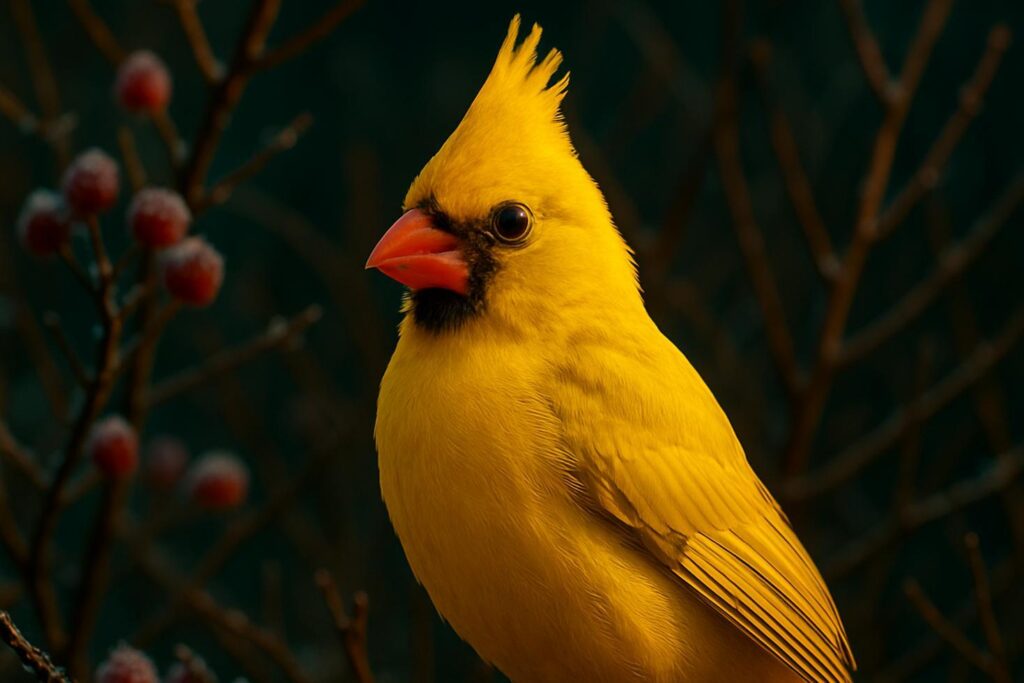
A yellow cardinal carries lutein and three specific yellow derivatives in place of four red keto-carotenoids — the conversion machinery stalled, not the bird.
A yellow northern cardinal is not a separate species or an albino. It is a northern cardinal whose body cannot complete the final biochemical step that converts yellow dietary carotenoids into red ketocarotenoids. That single failure leaves the bird wearing the raw yellow ingredients instead of the finished red color.
What makes that remarkable is how invisible the change is everywhere else. Same aggressive posture at the feeder. Same territorial song. The feathers simply never received the final chemical instruction.
How CYP2J19 Normally Builds Red Plumage
Red northern cardinals eat berries and seeds loaded with yellow carotenoids. Then CYP2J19 — expressed in skin, feathers, and liver — oxidizes those yellow compounds into red ketocarotenoids. In a yellow cardinal, that oxygenase-type oxidation step appears to fail. Alternative yellow metabolic routes stay open, producing the three yellow derivatives instead of stalling pigment metabolism entirely. The bird ends up fully pigmented, just in the wrong color register.
Research into the cardinal genome has identified candidate regulatory regions upstream of CYP2J19, including a long insertion and transcription factor binding motifs consistent with androgen-regulated control of red plumage. The exact mutation in any individual wild yellow cardinal is not confirmed unless the bird’s genome is sequenced.
What the Feather Analysis Actually Showed
Scientists analyzing feather samples from a mutant yellow cardinal found zero red compounds present. The four keto-carotenoids normal in red males were entirely absent. Lutein and three yellow metabolic derivatives had taken their place — the unprocessed upstream pigments, worn as finished color. The red was not lost. It was never synthesized.
This is a broader principle in red-plumaged birds: very few species absorb red pigment from food directly. Most build it. A yellow cardinal makes the failure of that construction visible.
Closing
Rare yellow cardinals surface occasionally in backyards and parks, distinct enough to stop people mid-step. The strangeness is biological, not cosmetic. One regulatory or enzymatic defect quietly redirected an entire pigment pathway, and the bird has no idea. It is simply cardinal, in yellow.
Frequently Asked Questions
Is a yellow northern cardinal a different species?
No. It is a northern cardinal with a genetic or regulatory defect affecting CYP2J19, the enzyme that converts yellow dietary carotenoids into red ketocarotenoids.
What pigments does a yellow cardinal have instead of red ones?
Feather analysis found lutein and three yellow derivatives — 3′-dehydrolutein, canary-xanthophyll A, and canary-xanthophyll B — replacing the four red keto-carotenoids found in normal males.
How rare are yellow northern cardinals?
They are occasionally spotted in the wild, but the scientific literature does not give a confirmed population frequency.
Does the yellow coloration affect the cardinal’s behavior?
The available research shows no behavioral difference — territory, song, and general activity remain consistent with typical northern cardinals.