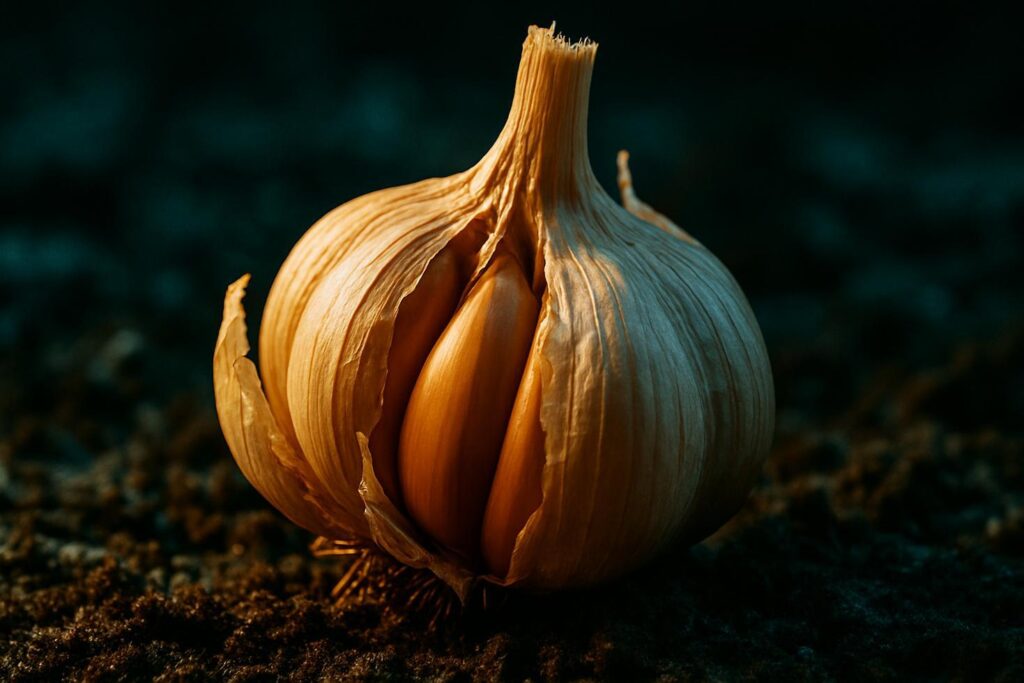
Garlic clocks 30–40 days at near-freezing temperatures — skip that cold and the bulb stays whole, one dense undivided round.
Garlic requires a cold period — called vernalization — to trigger the hormonal shift that splits a single bulb into individual cloves. Without it, the plant doesn’t fail. It grows, puts out leaves, and looks healthy. It just never divides.
That distinction is worth sitting with. The cold isn’t fuel for growth. It’s the signal that tells the plant what kind of growth to do.
How Garlic Measures Winter Cold to Begin Bulbing
The mechanism is hormonal. Low temperatures modify the plant’s internal hormone balance, and that shift — accumulated over time — is what eventually licenses clove formation.
Extension research from Oregon State puts the threshold at 6–8 weeks at a mean temperature below 40°F. University of Georgia guidance matches that figure. A peer-reviewed review adds useful texture: garlic exposed to 0–10°C for 8 weeks shows accelerated development, and controlled studies show the requirement can be met in roughly 30–40 days at 0–4°C, or stretched to 50–60 days if temperatures hover closer to 10°C.
The plant isn’t simply waiting for spring warmth. It’s counting cold.
What Happens Without Enough Cold Exposure
Inadequate vernalization doesn’t always mean total failure, but the outcomes are poor. The most documented result is a “round” — a single, undivided bulb with no internal clove architecture. In Hawaii, where natural winter cold is absent, CTAHR reports that without artificial refrigeration at 40°F for one to two months, growers typically see mostly vegetative growth and little-to-no bulb formation.
Variety matters here. Some cultivars need less cold than others. Variety-dependent cold thresholds mean a strain that bulbs reliably in Oregon may underperform entirely in a mild-winter climate without intervention.
Garlic planted in warm climates can be vernalized artificially through refrigeration — 40°F for one to two months, timed from October through December before planting. The biology doesn’t distinguish between a refrigerator and a winter field. It just counts the cold.
That’s what makes garlic unusual among vegetables. The harvest isn’t determined in the growing season. It’s decided in the dark, months before.
Frequently Asked Questions
What happens if garlic doesn’t get cold enough?
Without sufficient cold, garlic may form a single undivided round rather than separate cloves, or show little-to-no bulb formation at all.
How many weeks of cold does garlic need?
Extension sources cite 6–8 weeks below 40°F; controlled studies show 30–40 days at 0–4°C or 50–60 days near 10°C depending on variety.
Can garlic be vernalized in a refrigerator?
Yes. CTAHR Hawaiʻi recommends refrigerating seed cloves at 40°F for one to two months, from October through December, to mimic natural vernalization.
Does every garlic variety need the same amount of cold?
No. Cold requirements are variety-dependent, and some strains need considerably less cold than the general 6–8 week guideline.