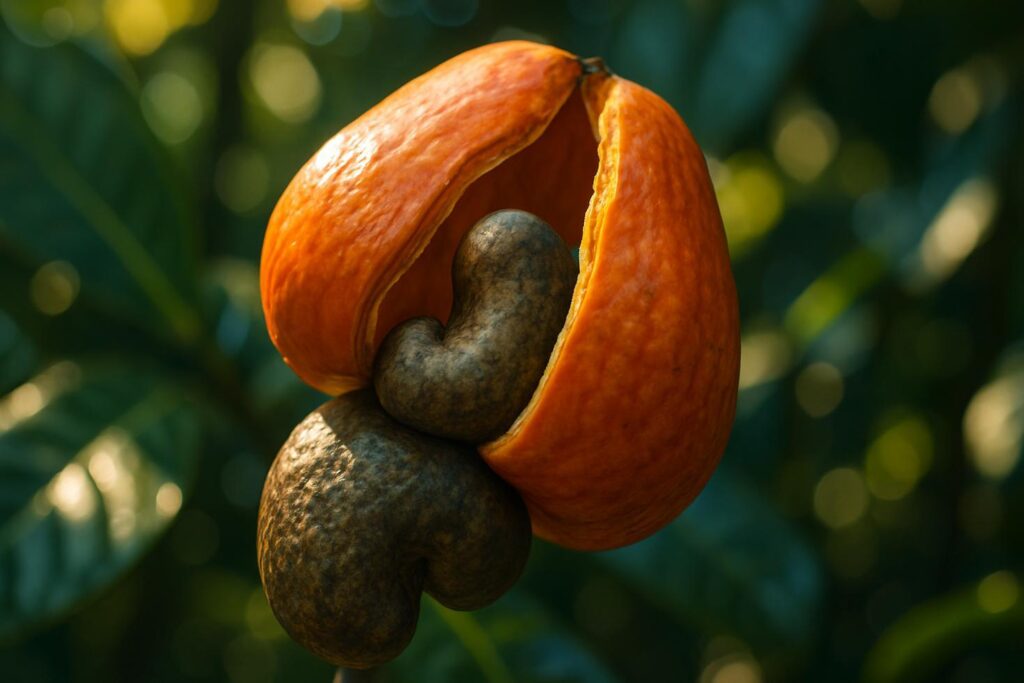
Cashew shells contain urushiol — the same oil in poison ivy. In 1982, 54 people developed poison ivy-like rashes from one under-processed batch. Every “raw” cashew on store shelves has already been heat-treated.
Every cashew sold in grocery stores has already been shelled and heat-treated before reaching the shelf — because the shell contains urushiol, the same allergenic oil responsible for poison ivy rashes. That single fact reframes what “raw” actually means on a cashew package. The nut inside is genuinely mild. The shell surrounding it is not.
Cashews belong to the Anacardiaceae family, alongside poison ivy, poison oak, mango, pistachio, and sumac. The shell holds cashew nut shell liquid (CNSL), a recognized skin irritant. Industrial processing — roasting or steaming at high temperatures — removes that contamination before the kernel reaches any consumer.
Quick facts:
– Cashew shells contain urushiol-like phenolic compounds, the same class of oil that causes poison ivy reactions
– Commercial “raw” cashews are still heat-treated; the label means unroasted after shelling, not literally unprocessed
– The reaction is a delayed allergic contact dermatitis, typically appearing 1 to 8 days after exposure
– A 1982 outbreak linked to under-processed imported cashews affected 54 people across the U.S.
– Around 20% of people who ate from a contaminated batch of more than 7,500 bags developed a rash
What the 1982 Cashew Outbreak Revealed About Urushiol Exposure
The 1982 case, documented in peer-reviewed medical literature, is the clearest evidence of what incomplete processing allows. Fifty-four people developed poison ivy-like dermatitis after eating imported cashew nuts. Symptoms appeared between 1 and 8 days after eating. Three individuals blistered inside their mouths. Four experienced rectal itching — evidence that urushiol surviving digestion irritates mucosal tissue throughout the digestive tract.
The contaminated supply reached more than 7,500 bags distributed across Pennsylvania and Maryland. Roughly 1 in 5 people who ate from an affected bag developed a visible reaction.
How Industrial Heat Processing Neutralizes Cashew Shell Oil
Removing the shell is not enough on its own. The processing step that matters is heat — either roasting or steaming at temperatures sufficient to neutralize the shell liquid’s allergenic compounds before the kernel is handled or packaged.
This is why store-label “raw” cashews are already cooked in the practical sense. They have been shelled, heat-treated to remove CNSL contamination, and only then packaged. The word “raw” on the label refers to their flavor profile relative to dry-roasted cashews — not to their processing history.
The reaction mechanism follows the same pathway as poison ivy exposure. Urushiol triggers delayed allergic contact dermatitis. The immune system mounts a response that can keep intensifying for days after initial contact, even after the urushiol itself is no longer present.
Closing
A nut with a reputation as one of the gentler snack foods carries a chemical history most shoppers never see. The processing infrastructure exists entirely because of what the shell holds. The kernel itself is the safe part — separated from its source by a step that cannot be skipped.
Every bag on the shelf is evidence that the step worked.
Frequently Asked Questions
Can a truly raw cashew, straight from the tree, cause a rash?
Yes. Outbreak data shows oral blistering and skin reactions from under-processed cashews, though severity depends on contamination level and individual sensitivity.
What is cashew nut shell liquid?
It is the oil found in the honeycomb layer of the hard cashew shell, classified as an irritant and containing urushiol-like allergenic phenolic compounds.
Are cashews related to poison ivy?
Yes. Both belong to the Anacardiaceae family, which also includes mango, pistachio, poison oak, and sumac.
What does “raw” mean on a cashew label?
It means the cashew was not dry-roasted after shelling — not that it skipped heat treatment. All commercially sold cashews are heat-processed before sale.