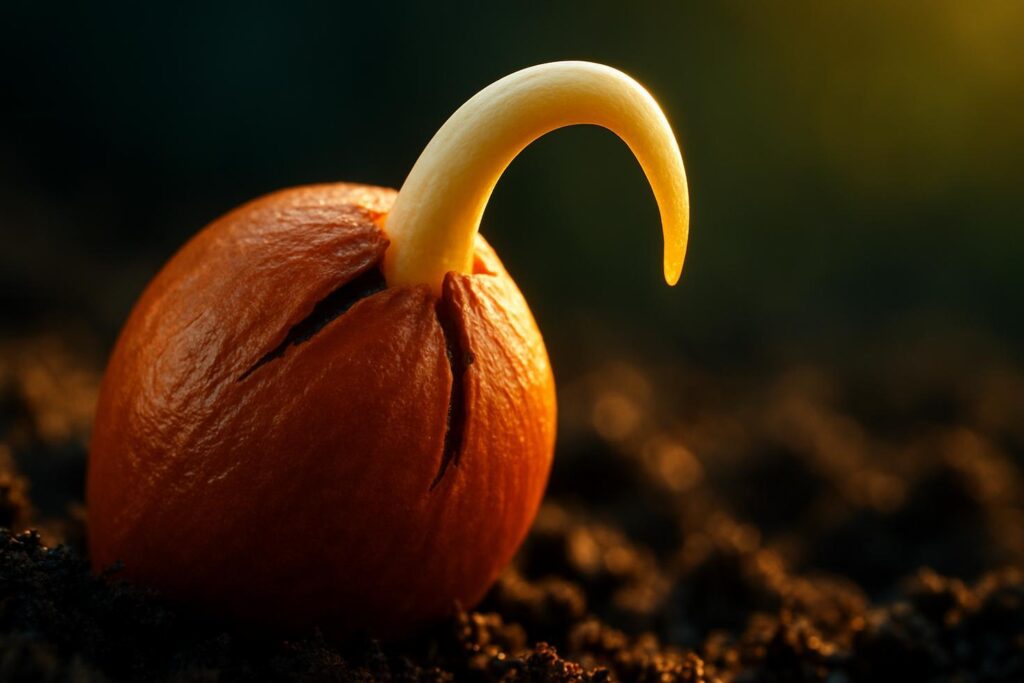
A tomato seed holds its embryo behind a small cap of tissue — and two competing hormones determine whether that cap ever weakens enough for the root to push through.
Inside every tomato seed, germination is a chemical contest with a physical outcome. Abscisic acid (ABA) suppresses the embryo while gibberellins (GA) work to weaken the endosperm cap — a ring of tissue pressed directly against the radicle tip. The root cannot emerge until that cap softens enough to let it through.
What looks like a dormant seed is actually a system waiting for three conditions to align simultaneously: water, oxygen, and warmth between 16–30°C. Below 10°C, the process stalls entirely.
How the ABA-Gibberellin Hormonal Balance Controls Tomato Dormancy
ABA is the brake. When ABA levels are high, the embryo stays dormant regardless of surrounding conditions. GA is the accelerator — it promotes the cellular processes that reduce resistance in the tissues surrounding the embryo.
Some tomato cultivars illustrate this directly. In cultivar LA2711, lower ABA content and reduced ABA sensitivity are both linked to measurably faster germination. The hormone balance isn’t just a switch; its exact calibration varies by genetic background.
Thermo-dormancy adds a second layer. Under high temperatures, tomato seeds can enter a physiological dormant state in the embryo itself — distinct from simple coat-imposed inhibition — where the hormonal argument stalls even when water and oxygen are available.
The Endosperm Cap: The Physical Gate Radicle Growth Must Breach
Once hormonal conditions favor germination, a mechanical problem remains. The endosperm cap sits directly over the radicle tip, and the embryo cannot push through by force alone. GA-driven enzymatic activity weakens the cap tissue progressively.
Germination is only complete when embryo growth potential exceeds surrounding tissue resistance. This framing — potential versus resistance — explains why germination isn’t simply “on” or “off.” It’s a balance that can tip slowly or quickly depending on how fast cap weakening proceeds.
Water uptake follows a triphasic pattern: rapid initial imbibition, a plateau phase, then a resumption as the radicle emerges. Radicle protrusion marks the end of germination by definition.
Closing
A tomato seed carries the tools for both dormancy and emergence inside the same tissue. The endosperm cap is the hinge. ABA and GA are the competing forces deciding whether that hinge ever opens. Once water, oxygen, and the right temperature arrive together, the balance tips — and a root appears within two weeks.
The stillness beforehand was never empty. It was negotiation.
Frequently Asked Questions
What hormone keeps a tomato seed dormant?
Abscisic acid (ABA) is the primary inhibitor. High ABA levels suppress embryo activity and prevent germination.
What physically stops the tomato root from emerging?
The endosperm cap — tissue directly over the radicle tip — must be weakened by gibberellin-driven processes before the root can push through.
At what temperature do tomato seeds stop germinating?
Tomato seeds fail to germinate below 10°C. The preferred range for active germination is 16–30°C.
Can high heat also prevent tomato seed germination?
Yes. High temperatures can induce thermo-dormancy, a physiological block within the embryo itself, not just a surface-level inhibition.