Lab studies confirmed lamb’s ear extract showed antimicrobial activity against vancomycin-resistant Staphylococcus aureus — the Staph strain that survives medicine’s last-resort antibiotic.
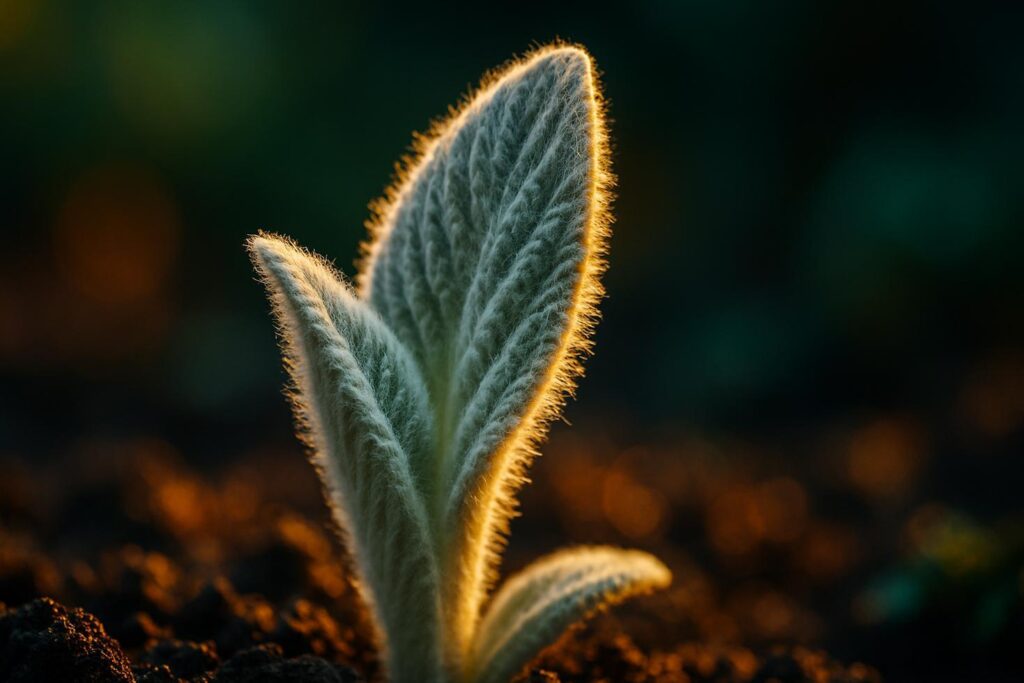
Lamb’s ear (Stachys byzantina) does two separate jobs at once: its dense woolly hairs physically absorb blood and press against a wound to help it clot, while compounds inside the leaf suppress bacterial growth. That combination — physical and chemical — is what makes this ordinary garden plant so consistently strange to look at twice. Folk medicine documented the wound-dressing use long before any laboratory confirmed the chemistry behind it.
The lab confirmation, when it came, landed on a remarkable target.
How Lamb’s Ear Leaves Create a Physical Wound Barrier
The surface of a lamb’s ear leaf is tomentose — a botanical term for densely matted, woolly hairs. This structure gives the leaf a thick, compressible texture that can press against a wound and hold position. Herbal references describe placing several whole leaves directly on a wound and covering them with gauze, using the leaves essentially as a natural pad.
The styptic effect — astringent compounds that slow blood flow — is consistently noted across folk medicine sources, including university-affiliated horticultural records. Astringents work by precipitating surface proteins and constricting local tissue. The exact biochemical pathway in S. byzantina is not yet fully characterized in the available research.
Lamb’s Ear Antimicrobial Activity Against Vancomycin-Resistant Staph
This is where the plant’s chemistry becomes genuinely difficult to set aside. Laboratory studies, referenced in the Wikipedia entry for Stachys byzantina, confirmed that plant extracts showed antimicrobial activity against Staphylococcus aureus resistant to vancomycin.
Vancomycin sits near the end of the clinical antibiotic chain. Physicians reach for it after standard options fail. Resistance to it signals a serious therapeutic gap that researchers are actively trying to close. Finding activity against that specific strain in a garden ornamental is the kind of result that earns a second look.
The compounds responsible likely belong to the flavonoid, phenolic acid, or essential oil families common across the mint family (Lamiaceae), though the precise profile for S. byzantina is not yet fully mapped. The activity is in vitro — confirmed in the lab, not yet in clinical trials.
Closing
Lamb’s ear is native to Turkey, Iran, and the Caucasus, and it arrived in Western gardens as an ornamental groundcover. It stayed because of how it looks. What the lab work added is a reason to look more carefully at why it is built the way it is. A leaf engineered by environment to survive heat and drought turns out to carry chemistry that a drug-resistant bacterium cannot simply shrug off.
The cottage garden and the hospital laboratory are not usually in the same sentence. Lamb’s ear keeps finding its way into both.
Frequently Asked Questions
What makes lamb’s ear leaves absorbent?
The leaves are covered in dense, woolly hairs that form a soft physical matrix capable of absorbing blood and wound exudate.
Did lamb’s ear actually work as a battlefield bandage?
Folk and herbal sources describe battlefield wound-dressing use, but no verified historical or military medical records confirm the specific duration or extent of that practice.
What bacteria does lamb’s ear extract work against in the lab?
Laboratory studies confirmed antimicrobial activity against vancomycin-resistant Staphylococcus aureus (S. byzantina extract).
Is lamb’s ear extract a proven medical treatment?
No. The antimicrobial activity is confirmed in vitro (laboratory setting only) and has not been validated in clinical trials.