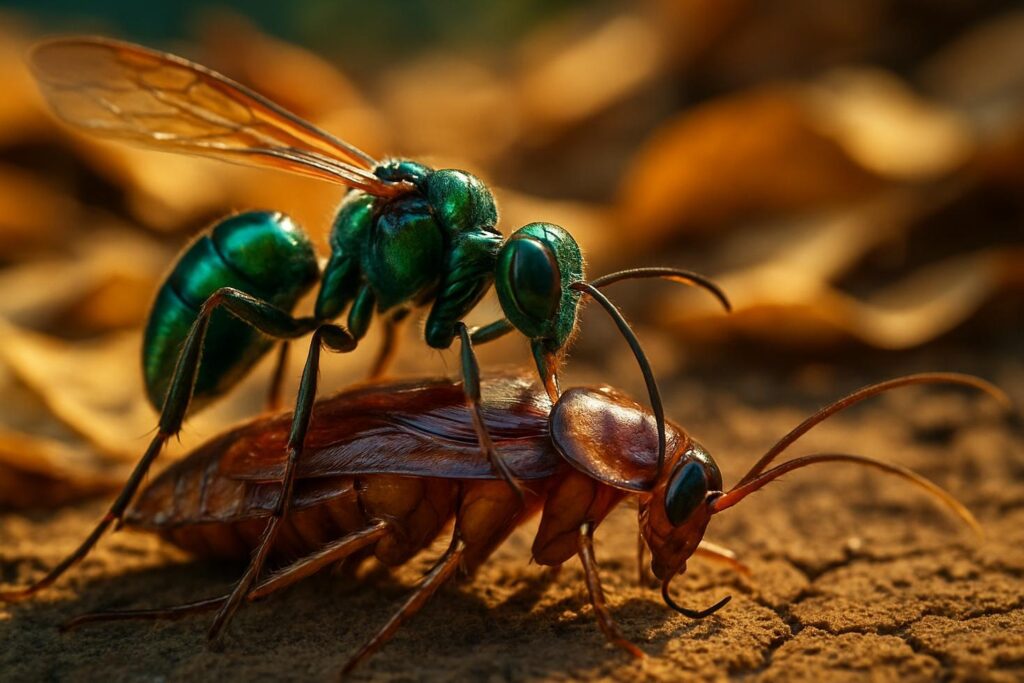
A single sting drops octopaminergic neuron firing to 20% of normal — escape circuits go quiet, grooming stays fully active, and the cockroach simply stops trying to leave.
The jewel wasp (Ampulex compressa) delivers venom directly into the cockroach’s brain ganglia, selectively suppressing the neural circuits that drive escape while leaving grooming completely intact. What follows is not paralysis. The cockroach cleans its antennae, responds to touch, and breathes normally — it simply stops initiating movement to flee, for roughly three weeks.
This isn’t a blunt chemical knockout. The wasp uses mechanosensory feedback from its stinger tip to locate specific neural targets inside the cockroach’s head before injecting.
What Jewel Wasp Venom Actually Does to the Cockroach Brain
The venom doesn’t destroy neurons. It rewires behavioral state by reducing excitatory drive to locomotor circuits. Octopaminergic neurons lose permissive drive to the thoracic motor system — the descending signal that normally says “walking is allowed” goes nearly silent.
Neural recording studies show three distinct phases after injection: an initial activity reduction lasting about 10 minutes, a rebound period of up to 25 minutes, then a longer suppression extending to 2 hours. After that window, the cockroach enters the prolonged hypokinetic state.
Why Grooming Stays Active While Escape Shuts Down
Grooming and escape run on separate neuromodulatory pathways. The venom’s dopamine component binds D1-like receptors to actively induce grooming. This is not a side effect — it’s a distinct pharmacological action.
The result is a cockroach that appears behaviorally normal in one dimension while being profoundly suppressed in another. Escape and grooming use independent descending circuits, which is exactly what allows venom to dial one down while leaving the other running.
What the Cockroach Becomes After the Sting
Once hypokinesia sets in, the wasp leads the cockroach by the antenna into a burrow. A single egg is laid on its leg. The cockroach survives — alive, metabolically slower, not fleeing — long enough to serve as a fresh food source for the developing larva.
The three-week lethargy window comes from one reported dataset. Other studies focus on the first two hours of neural dynamics. Both timescales are real; they describe different phases of the same venom’s effect.
Frequently Asked Questions
How does the jewel wasp find the right spot to sting?
The wasp uses mechanosensory receptors on its stinger tip to probe and locate the head ganglia by touch before injecting venom.
Does the cockroach feel pain after being stung?
The cockroach retains sensory responses — it still reacts to touch — but the venom suppresses the behavioral output that would normally trigger escape.
Is the cockroach actually paralyzed?
No. Paralysis implies motor system failure. The cockroach’s muscles work; it simply lacks the descending neural drive to initiate walking or escape on its own.
What happens to the cockroach’s metabolism?
Stung cockroaches consume less oxygen and lose less water than controls, indicating the venom also shifts metabolic rate alongside behavioral state.