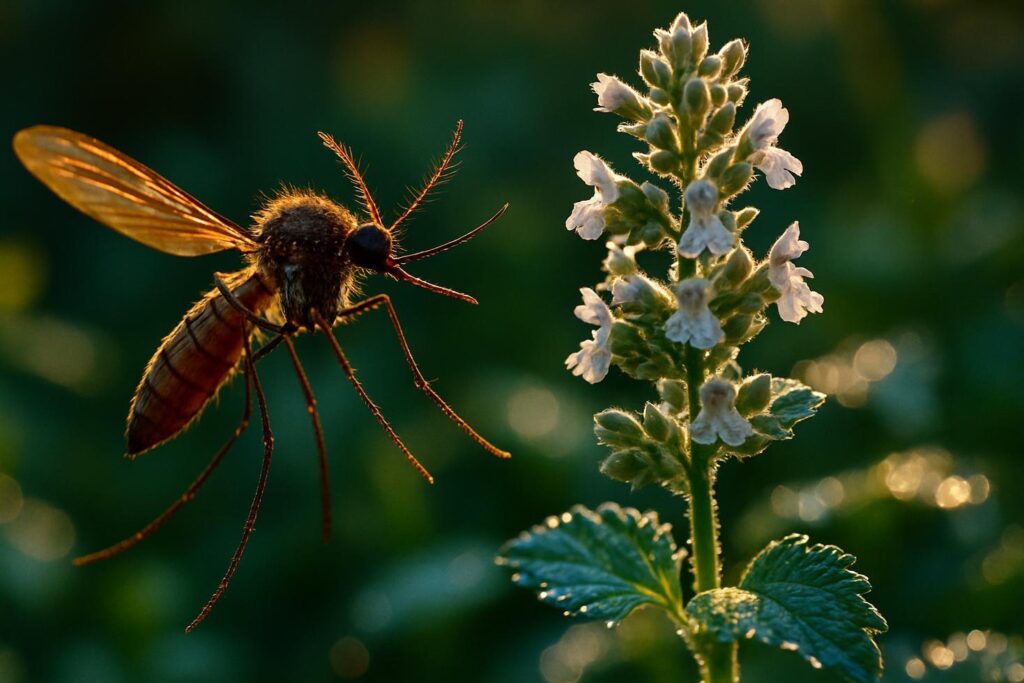
Catnip’s nepetalactone outperformed DEET at equivalent concentrations in a 2001 lab study — not by overwhelming the mosquito, but by cutting off the signal entirely.
Certain aromatic plants contain volatile oils that interfere directly with the olfactory receptors mosquitoes use to detect a living host. That interference isn’t about overwhelming a mosquito with a strong smell. It’s about blocking the chemical signals — carbon dioxide, lactic acid, skin warmth — that the insect depends on to navigate toward prey.
Catnip is the clearest example. Its active compound, nepetalactone, was shown in a 2001 laboratory study to outperform DEET as a mosquito repellent at equivalent concentrations. A compound a plant produces primarily to attract cats turned out to be a more effective olfactory disruptor than a synthetic chemical engineered specifically for that purpose.
Quick facts:
– Aromatic plant oils interfere with mosquito olfactory receptors, masking CO₂ and lactic acid cues
– Catnip’s nepetalactone outperformed DEET at equivalent concentrations in a 2001 lab study
– Performance varies by formulation, dose, and exposure — lab results don’t translate directly to garden conditions
– Crushing or brushing leaves releases significantly more volatile oil than an intact plant
– Lavender, mint, and lemongrass work through related but distinct volatile compounds
How Mosquito Olfactory Interference Actually Works
Mosquitoes don’t see their hosts — they smell them. They track gradients of CO₂ from breath, lactic acid from skin, and heat signatures. Volatile plant oils, particularly terpenoids like nepetalactone and linalool, appear to mask or block those host-detection receptor pathways. Without a readable signal, no hunt begins.
This mechanism applies across several plant families. Lavender produces linalool and linalyl acetate. Lemongrass and citronella grass produce citronellal, citronellol, and geraniol. Each compound acts on mosquito olfaction through its own chemical pathway, though the end result is similar: the host becomes harder to locate.
Why Catnip and DEET Produce Such a Striking Comparison
The 2001 study’s finding holds up as a data point, but context matters. Nepetalactone outperformed DEET at equivalent concentrations under controlled laboratory conditions. Later research and regulatory reviews note that real-world performance depends heavily on formulation, application dose, and exposure duration. A catnip plant growing undisturbed in a garden is not delivering nepetalactone at lab-study concentrations.
Crushing the leaves changes the equation. Intact plants release comparatively low levels of volatile oil into the surrounding air. Bruised or processed foliage releases far more. Distilled essential oils represent the highest concentration. Each step up the processing chain moves closer to the conditions that produce documented repellent effects.
What the Garden Evidence Actually Shows
Multiple extension and horticultural sources list catnip, lavender, mint, lemongrass, and bee balm as plants with genuine mosquito-deterrent properties. None of those sources provide quantified field data on mosquito bite-rate reduction from garden plantings alone. The qualitative consensus is consistent: these plants create a less hospitable olfactory environment in their immediate vicinity, particularly when foliage is disturbed.
Whole, unprocessed garden plants should be understood as partial deterrents in a local area, not complete protection. Water management, screens, and clothing remain the primary tools. The plants add a real but limited layer.
The 2001 nepetalactone finding still catches researchers off guard decades later. One compound, produced by a plant with no apparent interest in mosquito control, outperforming a purpose-built synthetic — at the same dose, in the same test. Nature doesn’t optimize for elegance. But sometimes the mechanism lands there anyway.
Frequently Asked Questions
Does catnip actually repel mosquitoes better than DEET?
In a 2001 laboratory study, nepetalactone outperformed DEET at equivalent concentrations. Real-world effectiveness depends on formulation and dose, and a garden plant won’t replicate lab conditions.
Why do plant oils interfere with mosquito navigation?
Volatile terpenoids appear to block or mask the olfactory receptors mosquitoes use to detect CO₂ and lactic acid, making a nearby host harder to locate.
Do whole plants provide enough protection to skip other repellents?
No. Extension sources consistently note that intact plants release low concentrations of volatile oil. Crushing leaves or using formulated products increases effectiveness significantly.
Which compounds in aromatic plants are most studied for mosquito repellency?
Nepetalactone (catnip), linalool (lavender), and citronellal and geraniol (lemongrass and citronella grass) have the strongest documented evidence in these sources.