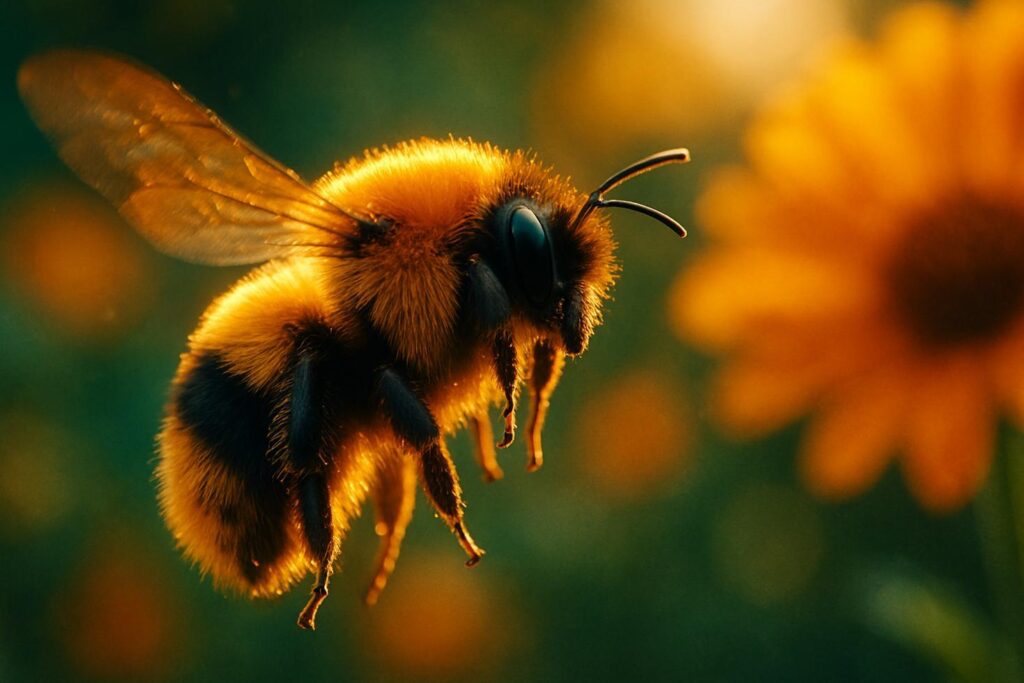
A bumble bee’s thorax runs 15–16°C hotter than the surrounding air — and the bee fans and repositions itself to shed that heat. Where it lingers is a working thermal indicator.
A bumble bee in flight carries a built-in heat problem. Its thoracic muscles generate enough friction to keep that region 15–16°C above ambient air temperature — a finding measured directly in Bombus terrestris — and that heat cannot simply be switched off mid-flight.
What follows from that physics is visible behavior. The bee repositions its body, spreads its legs, and fans air across its abdomen to prevent overheating. The same principle applies at the nest entrance, where workers fan coordinated airflows that can drop interior temperature by roughly 10°F.
How a Bee’s Thorax Generates and Sheds Heat
Flight muscles do the work, and friction is the byproduct. The thorax is where that energy concentrates — measurably hotter than the abdomen in every individual studied.
In Xylocopa pubescens, the hot spot reached 18–19°C above ambient, with a spread of 11–20°C between thorax and gaster tip. That range reflects variable but consistent prothoracic heat generation across individuals, not a fixed output.
Fanning and postural shifts bleed off excess heat. Overheating becomes a real constraint as ambient temperature climbs toward 30°C, because the thermal gradient between bee and air narrows, reducing the efficiency of passive heat loss.
What Bee Foraging Patterns Reveal About Garden Microclimates
Foraging honeybees showed thoracic surface temperatures ranging from 23.2 to 44.2°C across different plants, dates, and ambient conditions — a spread that reflects how dramatically local conditions vary even within a small area.
Shaded or sheltered spots can run several degrees cooler than fully exposed ground nearby. Frost pockets — low areas where cool air settles — can drop further still. Bee activity reflects these local thermal differences because a bee encountering a warmer patch faces a narrower heat-loss gradient and may not linger.
This is not a documented mapping behavior. Bees are not reading the yard for human benefit. But their presence and posture at a given spot are real-time outputs of the thermal environment they are navigating.
Closing
Forty years of watching gardens makes one thing clear: bees are not casual visitors. Every landing and departure is shaped by temperature, airflow, and shade in ways a weather station placed two feet away would never detect. The bee fanning at a nest entrance is running the same calculation as the one repositioning on a flower — just on a different scale. The yard is not uniform. The bees have already measured it.
Frequently Asked Questions
How much hotter is a bumble bee’s thorax than the air around it?
Measured in Bombus terrestris, the thoracic hot spot runs 15–16°C above ambient air temperature during flight.
Can bees control the temperature inside their nest?
Yes. Bumble bee workers fan at the nest entrance and can reduce interior temperature by approximately 10°F through coordinated airflow.
Do carpenter bees thermoregulate the same way bumble bees do?
Large carpenter bees (Xylocopa pubescens) show a similar prothoracic hot spot, measured at 18–19°C above ambient — slightly larger than the bumble bee equivalent.
At what temperature do bees risk overheating while foraging?
For foraging honeybees, overheating becomes a meaningful concern as ambient temperature approaches approximately 30°C.