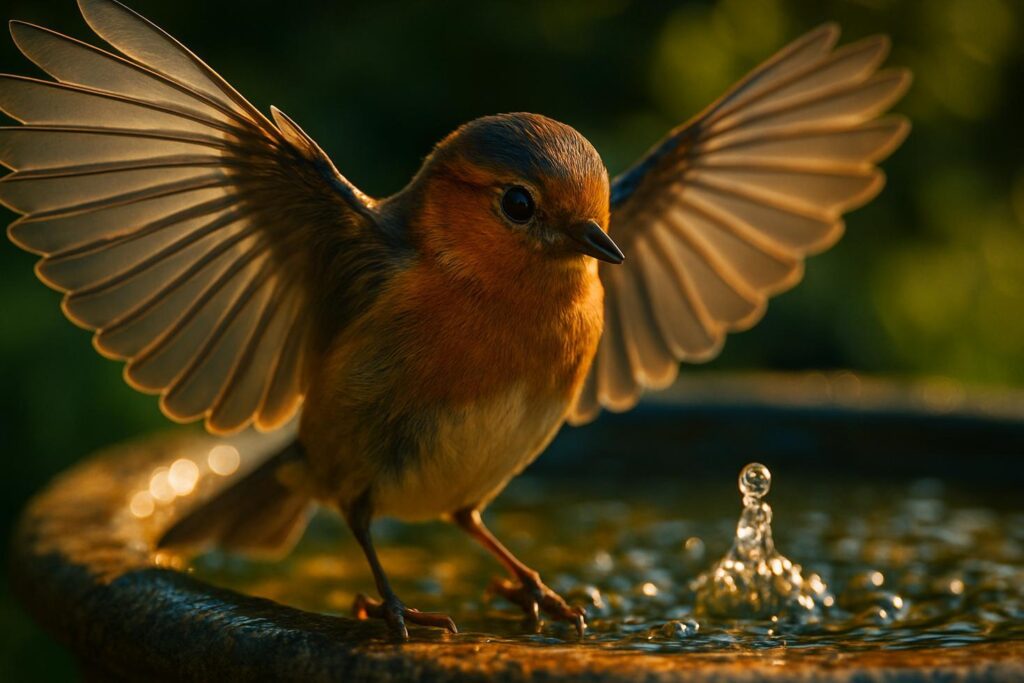
A still birdbath waits to be seen. One drip per second creates both the ripple and the sound — the two cues that make moving water noticeable to birds a static basin never produces.
A birdbath with moving water is detectably different to birds than a still basin — not just visually, but acoustically. That distinction matters more than most backyard birders realize. A garden can have the most carefully positioned basin imaginable, and a passing warbler may never register it exists.
Birds use a combination of auditory and visual cues to locate water. Still water produces neither. A dripper or bubbler generates a repeating sound and a constantly shifting surface — two separate signals working simultaneously to announce the water’s presence.
How Auditory and Visual Cues Work Together to Signal Water
Dripping water creates a repeating sound pattern. That pattern is different from wind noise, rustling leaves, or ambient garden sounds. Birding sources consistently describe this acoustic signal as a meaningful cue for birds moving through tree canopy and dense shrubs.
The visual component works in parallel. Ripples scatter and reflect light differently with every new drop, producing a flicker that avian visual systems — highly sensitive to motion — register readily. A smooth, still surface reflects light uniformly and offers no comparable flicker signal.
The result is that moving water signals through two channels at once rather than one.
What Drippers and Bubblers Actually Do Differently Than Still Basins
A dripper suspended roughly 12–18 inches above the basin surface, releasing approximately 1 drop per second, generates both cues continuously. A bubbler pump produces a similar effect from below. A still basin generates neither.
Georgia Wildlife specifically states that moving water can increase both the number and variety of visiting birds, while noting the underlying reasons are not fully understood. That honest caveat matters: the mechanism is real, but the exact detection range and species-specific responses remain unquantified in the available research.
Moving water also resists stagnation, which keeps the basin fresher between cleanings.
Frequently Asked Questions
Do birds actually hear a birdbath from inside nearby shrubs?
Birding sources describe dripping and splashing as auditory cues that birds can detect while sheltered in vegetation, but exact detection distances are not established in available research.
How deep should a birdbath be to attract birds?
Birding and wildlife sources recommend no deeper than 2–3 inches at the center, shallow enough for small birds to wade safely.
Is 1 drip per second actually enough to make a difference?
That rate appears consistently in birding guidance as sufficient to generate both sound and ripple cues, though it has not been tested in controlled studies in the available sources.
Does moving water in a birdbath prevent mosquitoes?
Sources note that moving water discourages stagnation, which is the condition mosquitoes require to breed, but a specific prevention rate or threshold is not quantified in the available research.