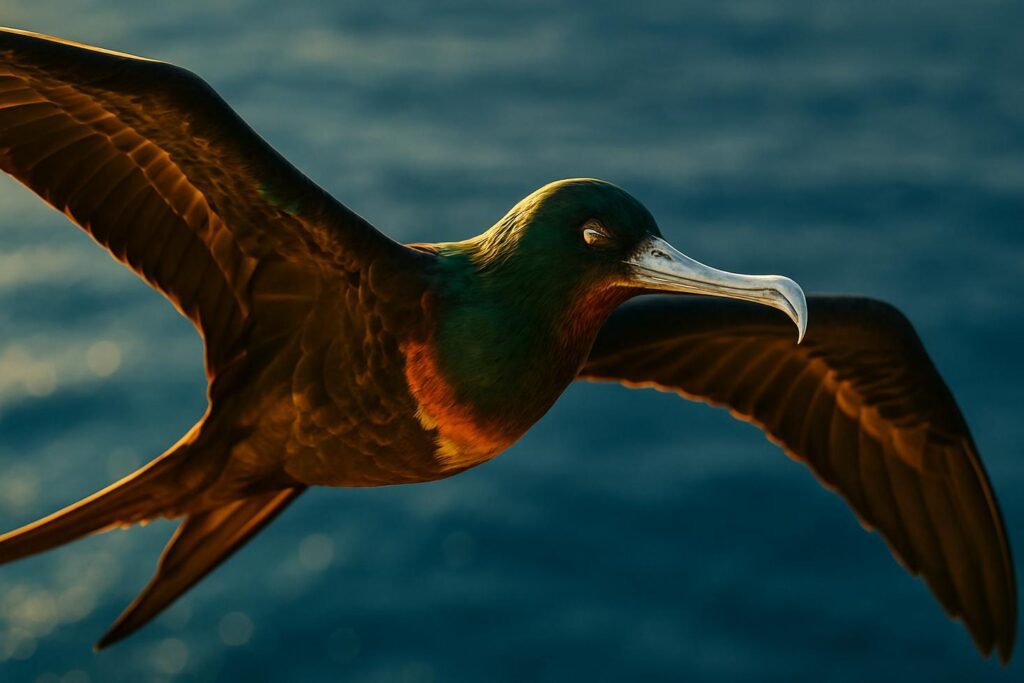
Great frigatebirds log 10 days airborne over open ocean — yet sleep adds up to just 2.89% of flight time, against 53% on land.
Great frigatebirds can remain airborne over the open ocean for up to 10 days continuously, and they do sleep during that time — just barely. The numbers make the behavior feel almost impossible: 2.89% of flight time spent sleeping, compared to 53.28% of time sleeping on land. That gap is where the biology gets interesting.
Fourteen birds were tracked in the peer-reviewed study behind these figures. What researchers found wasn’t a bird that stops sleeping — it’s a bird that compresses sleep into the narrowest possible window a brain can tolerate.
How Unihemispheric Sleep Keeps Frigatebirds Airborne
The mechanism is called unihemispheric slow-wave sleep: one hemisphere of the brain enters a sleep state while the other remains awake. The bird never fully loses consciousness. Then the hemispheres trade roles.
Researchers also recorded episodes of bilateral sleep — both hemispheres down simultaneously — but these were brief and rare. The birds accumulated only about 45 minutes of total sleep per day in flight, often in bursts as short as 10 seconds.
Why Circling in Thermals Is When Frigatebirds Sleep
Sleep didn’t happen randomly across flight. It clustered during circling in rising air currents — thermals that reduce the active muscular effort of staying aloft. Soaring in thermals lowers the cost of sustained flight, and that window appears to be when the brain takes what it can get.
On land, the same birds slept up to 12 hours at a time. The contrast isn’t a curiosity — it reveals the minimum sleep a frigatebird brain requires to sustain a 10-day oceanic crossing.
Frequently Asked Questions
How long can a great frigatebird fly without landing?
Peer-reviewed research tracked great frigatebirds flying continuously over the ocean for up to 10 days without landing.
Do frigatebirds actually sleep while flying?
Yes. Researchers confirmed sleep through EEG recordings, documenting both unihemispheric and brief bilateral slow-wave sleep during flight in 14 tracked birds.
How much do frigatebirds sleep in the air compared to on land?
In flight, frigatebirds sleep about 2.89% of the time. On land, that figure rises to 53.28% — a roughly 18-fold difference.
What is unihemispheric slow-wave sleep?
It is a sleep state in which one brain hemisphere rests while the other remains active, allowing an animal to maintain some behavioral function during sleep.