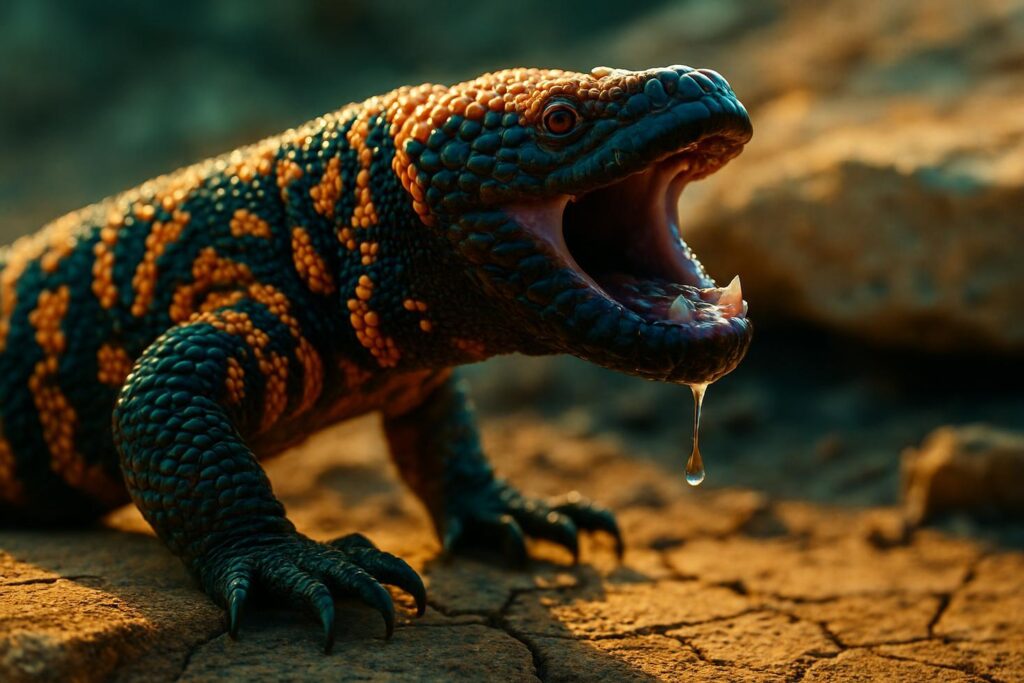
A Gila monster peptide persists in the human body for hours — while native GLP-1 breaks down in under two minutes — and that gap became the blueprint for an entire drug class.
A peptide pulled from Gila monster venom became the biological model for the GLP-1 receptor agonist drug class, which includes exenatide and, later, semaglutide (Ozempic). That sentence sounds like a stretch until the mechanism comes into focus. The Gila monster (Heloderma suspectum) produces a venom compound called exendin-4 that binds the same receptor in the human body that regulates insulin release and appetite signals. Researchers didn’t engineer a new pathway. They found one already operating inside a desert reptile — and then asked why it lasted so much longer than the human version.
The answer reshaped metabolic medicine.
How Exendin-4 and the Human GLP-1 Signal Differ
Human glucagon-like peptide-1 (GLP-1) is rapidly degraded in the bloodstream — gone in under two minutes. Exendin-4, the Gila monster peptide, persists for hours under the same conditions. Both molecules act on the same GLP-1 receptor, triggering insulin secretion and contributing to appetite regulation. That hours-versus-minutes difference in staying power showed scientists what a long-acting version of this signal could look like — and that it was achievable.
John Eng, Jean-Pierre Raufman, and John Pisano led the work isolating exendin-4 from Gila monster saliva, research that developed through the 1980s and into the early 1990s.
The Drug Class Exendin-4 Made Possible
The first synthetic drug built from this discovery was exenatide (Byetta), which received FDA approval for type 2 diabetes in 2005. It was the first GLP-1-based therapy approved for clinical use.
Semaglutide — marketed as Ozempic — came later. It is a synthetic analog of human GLP-1, not a derivative of venom, but its design was informed by the same receptor biology that exendin-4 made legible. Ozempic received FDA approval in 2017. Wegovy, the higher-dose version for weight management, followed in 2021.
The Gila monster wasn’t producing exendin-4 to solve anything. The peptide’s durability was a feature of the animal’s biology, not a signal aimed at human medicine. What researchers did was notice the mismatch in half-life and follow it.
Closing
A slow-moving lizard native to the Sonoran Desert was carrying a molecule that fit a receptor humans hadn’t fully mapped yet. The gap between two minutes and several hours — the difference in how long two versions of the same signal survive in the body — turned out to be the exact question metabolic drug development needed to ask.
Sometimes the blueprint arrives before anyone knows what’s being built.
Frequently Asked Questions
What is exendin-4 and where does it come from?
Exendin-4 is a peptide isolated from the saliva of the Gila monster (Heloderma suspectum) that binds the same GLP-1 receptor in humans that regulates insulin secretion and appetite.
Is Ozempic made from Gila monster venom?
No. Ozempic (semaglutide) is a synthetic analog of human GLP-1, inspired by exendin-4 research but not derived directly from venom.
When was the first GLP-1 drug based on this research approved?
Exenatide (Byetta), the first GLP-1 receptor agonist for type 2 diabetes, received FDA approval in 2005.
Why did exendin-4 matter so much to drug developers?
Unlike native human GLP-1, which breaks down in under two minutes, exendin-4 persists for hours — demonstrating that a long-acting GLP-1-based drug was biologically feasible.