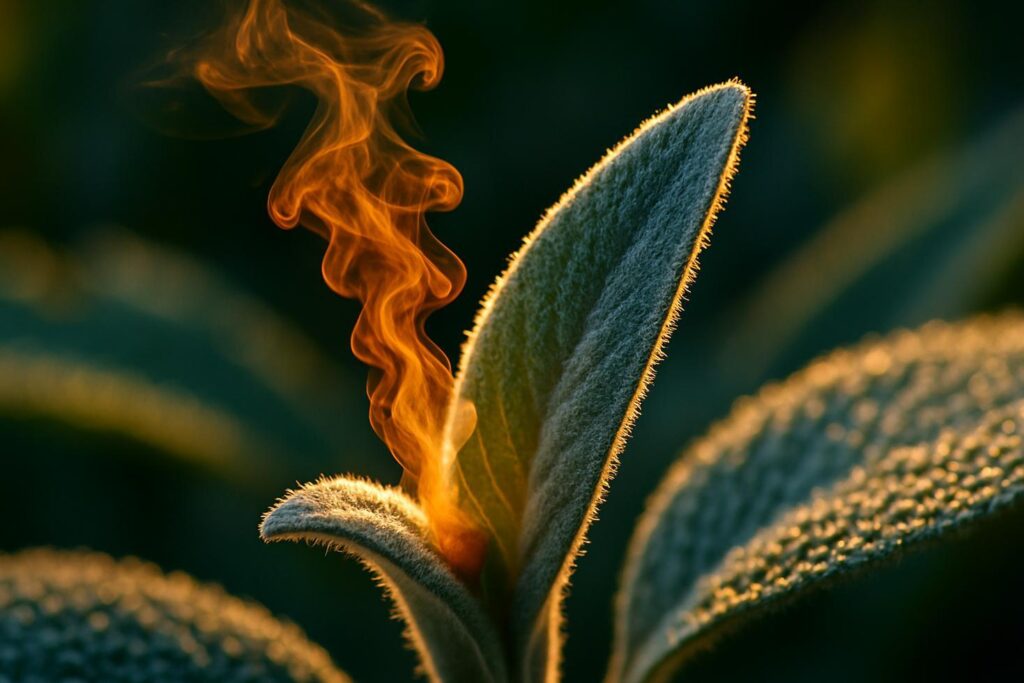
Sage’s volatile oils sit sealed inside microscopic leaf glands — a sage and patchouli combination delivered 270 minutes of median protection against Aedes dirus mosquitoes, but species, formulation, and extraction method all shift that number significantly.
Sage essential oils can disrupt mosquito host-seeking behavior by acting on chemoreceptors in the antennae, maxillary palps, and other sensory structures — but only under the right conditions. That distinction matters enormously. A fresh leaf held in the hand is a very different delivery system than a formulated essential oil blend, and the research treats them very differently too.
The volatile compounds responsible — camphor, eucalyptol, linalool, and others — are stored in glandular trichomes on the leaf surface. Physical damage releases them, but the amount, composition, and actual repellency depend on species, cultivar, freshness, and growth conditions.
How Sage’s Glandular Trichomes Store and Release Volatile Compounds
The glandular structures on sage leaves function as sealed reservoirs. Crushing or heating the tissue ruptures them and releases the oil. What comes out, though, is not a single consistent compound — it is a mixture whose profile shifts with the species and even the cultivar. Salvia elegans essential oil runs to 38.73% spathulenol. S. splendens Blue Ribbon is dominated by β-cubebene at 22.9%. These are chemically distinct profiles producing distinct biological effects. Volatile composition varies dramatically across Salvia species — which is why “sage” as a category is too broad to predict repellency without knowing which plant is actually involved.
How Sage Volatiles Interfere with Mosquito Chemoreception
Mosquitoes locate hosts through a layered system of chemical cues: carbon dioxide, body warmth, and skin-emitted compounds detected by receptors in the antennae, maxillary palps, labella, and tarsi. Plant volatiles from sage don’t mask those signals by coating skin. They act on the mosquito’s chemoreceptor system directly, altering host-seeking behavior at the sensory level. Olfactory interference at the receptor level is the mechanism — not a physical barrier. This is why the effect is real in formulated oils but hard to replicate with a crumpled fresh leaf, where volatile output is inconsistent.
What the Larvicidal Data Adds to the Picture
Sage oils also show activity against mosquito larvae. S. elegans essential oil reached an LC50 of 46.4 ppm against Aedes albopictus larvae at 24 hours. S. splendens Blue Ribbon hit an LC50 of 59.2 ppm against the same species. These are separate from the adult-repellency findings, but they confirm that Salvia chemistry acts on mosquitoes at multiple life stages — not only through airborne olfactory disruption.
Sage built a chemical defense system for reasons that had nothing to do with mosquitoes — deterring herbivores and pathogens came first. Mosquito repellency appears to be a secondary effect of that same chemistry. The 270-minute protection window is real, but it belongs to a specific formulation, a specific species pairing, tested against a specific mosquito. That specificity is the whole story.
Frequently Asked Questions
Does burning sage repel mosquitoes?
Smoldering sage can deliver volatiles into the air and mask host odors through smoke, but duration and efficacy are limited and not equivalent to standardized repellents like DEET.
Can rubbing fresh sage leaves on skin repel mosquitoes?
Evidence for fresh leaves rubbed by hand is weak. Volatile output from manual crushing is inconsistent and depends heavily on species, cultivar, and freshness.
Which sage species is most effective against mosquitoes?
No single species is universally strongest. S. elegans showed an LC50 of 46.4 ppm against Aedes albopictus larvae — among the lower values measured, indicating higher larvicidal potency.
How long does sage essential oil repellency last?
In testing, a sage-and-patchouli blend provided 270 minutes of median protection against Aedes dirus. A basil-and-sage blend provided 150 minutes against Aedes aegypti. Both figures are formulation- and species-dependent.