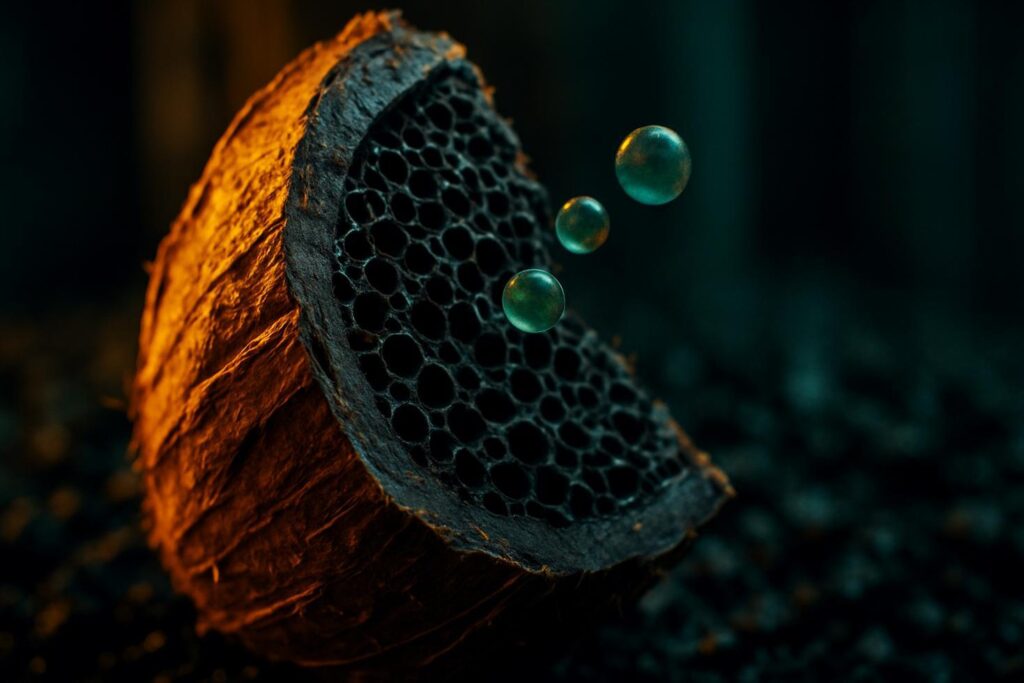
One gram of coconut shell activated carbon — about the weight of a paperclip — holds 857 m² of internal surface. KOH activation pushes that past 1,135 m²/g. That’s where contaminants disappear.
Coconut shell activated carbon removes contaminants through adsorption, a process where molecules lock onto pore walls rather than dissolving into a material. The shell itself is the key starting point: high fixed carbon content, low ash, and natural hardness make it unusually well-suited to developing the dense microporous networks that drive this performance. What looks like a throwaway material becomes something quietly extraordinary under the right conditions.
The transformation happens through controlled heating without oxygen. The organic structure doesn’t combust — it collapses inward, creating a hierarchy of tunnels and chambers at the nanometer scale. Those pores, not the carbon itself, do the capturing.
How the Activation Process Builds the Pore Network
Raw coconut shell contains almost no useful porosity. Activation — whether through CO₂ at 750°C or chemical treatment with KOH at a 2:1 ratio — is what generates performance. CO₂ activation at 750°C for 4 hours produces a surface area of 613 m²/g. KOH activation reaches 1,135 m²/g with a total pore volume of 0.442 cm³/g.
Pore size distribution controls what gets trapped. Small molecules diffuse into micropores readily; larger molecules need mesopores and connected pore pathways. This means activation conditions aren’t just about maximizing surface area — they shape which contaminants the carbon can actually intercept.
The Adsorption Mechanism and Contaminant Range
Adsorption here isn’t one single force. Pore filling, hydrogen bonding, hydrophobic interactions, surface charge effects, and aromatic interactions all contribute depending on the contaminant’s chemistry. Research shows pseudo-second-order kinetics fit observed data with R² above 0.97, and Langmuir isotherms fit with R² above 0.94 — both pointing to surface-site-limited binding rather than simple physical trapping.
The three-stage sequence researchers document — surface adsorption from 0 to 2 hours, pore diffusion from 2 to 8 hours, dynamic equilibrium from 8 to 48 hours — shows contaminant capture continuing long after initial contact. Documented targets include pesticides, dyes, phenolic compounds, hormones, antibiotics, heavy metals, and emerging industrial chemicals. Removal efficiency stays above 85% across a wide pH range, and common coexisting ions like chloride, sulfate, and calcium don’t block performance.
What Coconut Shell Activated Carbon Actually Is — and Isn’t
The raw shell produces none of this alone. Every performance figure in the literature comes from activated material produced under specific, engineered conditions. Adsorption capacity also varies sharply by contaminant: 261.64 mg/g for F-53B under tested conditions, but that number shifts with molecule size, surface chemistry, and contact time.
The structure rewards specificity. Knowing what a given activated carbon was optimized for matters more than the surface area figure alone.
This is what forty-plus years of watching materials science teaches: the most capable traps rarely look capable from the outside. A coconut shell is convincing evidence.
Frequently Asked Questions
What contaminants does coconut shell activated carbon remove?
Documented targets include pesticides, dyes, phenolic compounds, hormones, antibiotics, heavy metals, and persistent industrial chemicals like F-53B.
How much surface area does coconut shell activated carbon have per gram?
Standard activation reaches 857.69 m²/g; KOH activation at a 2:1 ratio produces up to 1,135 m²/g.
How long does adsorption take to reach completion?
Research documents a three-stage process: surface adsorption in the first 2 hours, pore diffusion from 2 to 8 hours, and dynamic equilibrium reached between 8 and 48 hours.
Does pH affect how well coconut shell activated carbon works?
Removal efficiency stays above 85% across a wide pH range, though diazinon removal peaked at 92.16% specifically at pH 3.