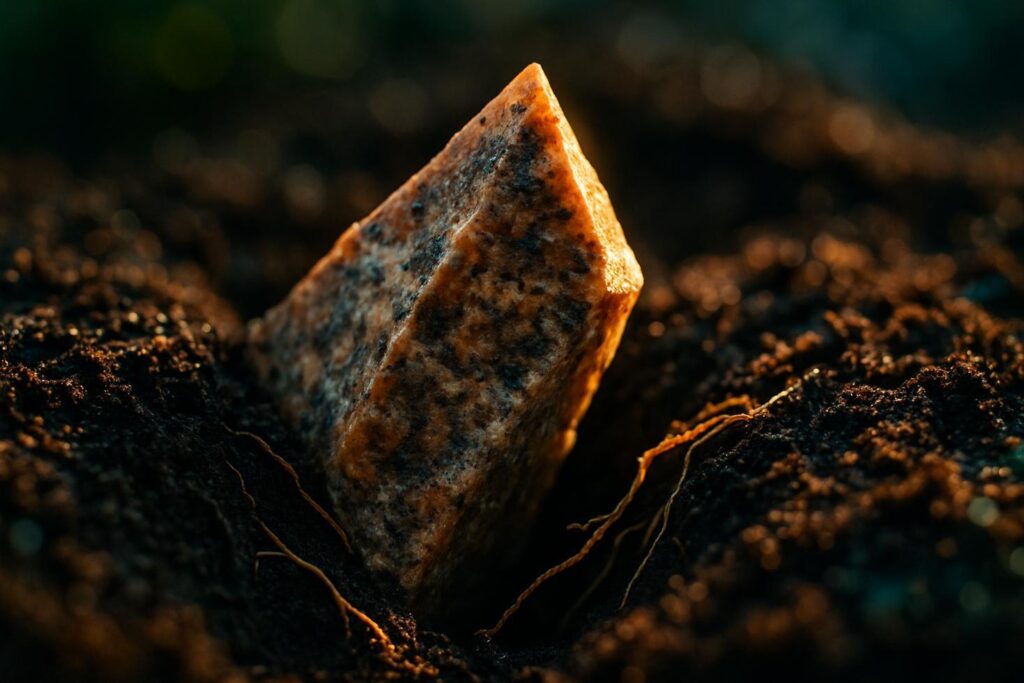
Crushed granite fed to chickens comes in three sizes — the coarsest fragments, up to 6 mm, wedge soil particles apart and hold gaps open even when the mix is saturated.
Chicken grit — crushed granite or flint fed to birds so their gizzards can grind food mechanically — works as a drainage amendment in succulent and alpine soil for exactly the same reason it works inside a bird: hard, angular particles that refuse to compress or stack. That stubborn geometry is the whole mechanism. Horticulturalists recommend it specifically for plants that need sharp drainage: succulents, cacti, rock-garden alpines, lavender, and bonsai.
The improvement is purely physical, not chemical or biological. Mineral grit carries no nutrients. It changes nothing about soil pH. It simply occupies space in a way that fine particles cannot fill around it.
Quick facts:
– Chicken grit is commonly granite or flint — pH neutral and insoluble
– It comes in three sizes; horticultural use favors the coarser range, roughly 1–6 mm
– Coarse mineral fragments create larger pore spaces, letting water drain faster
– Air fills those pores after water passes through, which roots require for gas exchange
– The same amendment benefits clay soils by resisting compaction and improving root penetration
How Grit Particle Size Controls Soil Pore Space
Clay particles are fine and flat. They stack like wet paper and seal out air almost completely. Granite and flint fragments are coarse and angular. They cannot stack. When mixed into a potting blend, angular particles physically wedge soil apart, holding gaps open that water drains through quickly and air moves into behind it.
The relevant size range for horticultural grit runs roughly 1–6 mm depending on the source. That range is large enough to create air-filled pore space around roots but small enough to blend evenly through a pot mix. Below that range, particles compact too easily. Above it, the mix loses structural stability.
Which Plants Actually Benefit from Mineral Grit Amendments
The plants recommended most consistently for grit amendment are those adapted to fast-draining native environments: succulents, cacti, alpines, bulbs, lavender, rosemary, and bonsai. These plants evolved in rocky or sandy soils where water moves through quickly.
Root tissue breakdown from oxygen deprivation is the failure mode grit prevents. When water stagnates around roots, oxygen disappears from the pore space. Root cells break down from the outside in — a process that begins well before any visible wilting. Grit keeps the drainage rate high enough that pore space refills with air before that process starts.
The same principle applies to other inert drainage materials — pumice, perlite, rice hulls, crushed stone — but chicken grit is particularly accessible because it is sold as a standard poultry supply and is already sized and cleaned for use.
Closing
What makes grit amendments worth understanding is that the mechanism is entirely geometric. No chemistry is involved. A granite shard does not interact with soil chemistry or biology — it simply refuses to move when wet soil tries to compact around it.
That passivity is exactly the point. The pore space it holds open does the work.
Frequently Asked Questions
Is chicken grit the same as horticultural grit?
Both are coarse crushed stone, commonly granite or flint, used for drainage. Chicken grit sold for poultry is functionally the same material and is used interchangeably by many gardeners.
What particle size of grit works best for succulent soil?
Horticultural sources cite a range of roughly 1–6 mm. That range opens pore space without making the mix too loose to hold plant roots.
Does chicken grit change soil pH or add nutrients?
No. Granite and flint grit are insoluble and pH neutral. The amendment is purely physical — it adds no nutrients and does not alter soil chemistry.