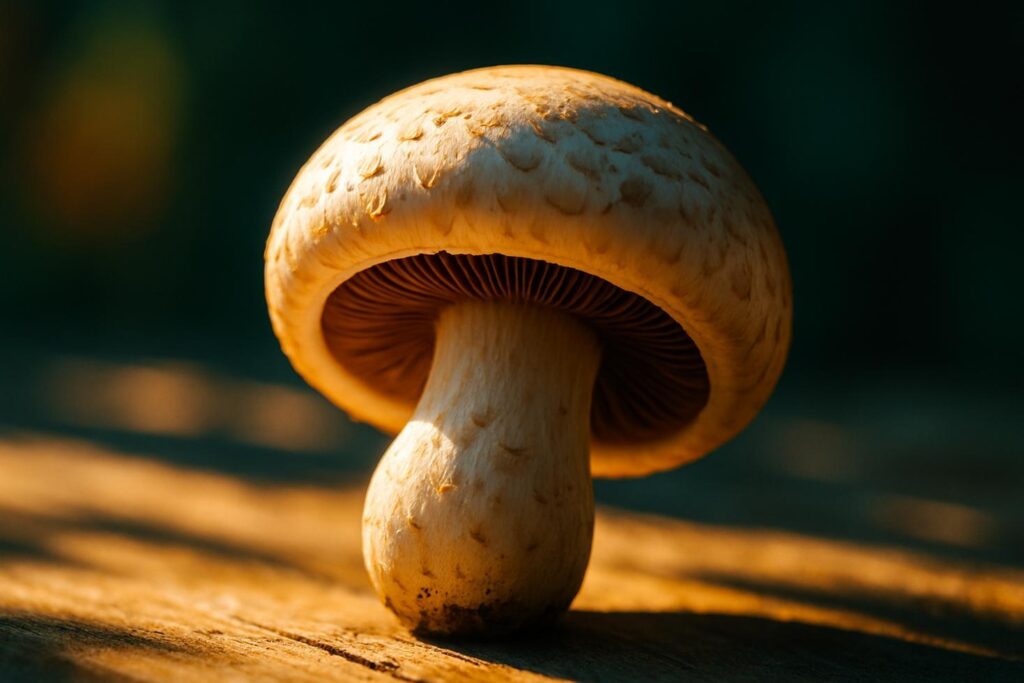
100 grams of sliced button mushrooms hit 17.5 micrograms of vitamin D2 after just 15 minutes of midday summer sun — that’s 175% of the daily estimated average requirement.
Sliced button mushrooms exposed to midday summer sunlight produce 17.5 micrograms of vitamin D2 per 100 grams in just 15 minutes — 175% of the Institute of Medicine’s estimated average requirement of 10 micrograms per day. What makes that number stranger is the mechanism behind it. UV-B radiation, in the 280–315 nm range, strikes a compound called ergosterol in the fungal tissue and converts it photochemically into vitamin D2. The same basic photochemical logic applies to human skin, just with different starting compounds.
Ergosterol sits close enough to the mushroom’s surface that UV-B reaches it almost immediately. Slicing the mushrooms increases exposed surface area, putting more ergosterol in direct contact with incoming photons.
How Sunlight Dose Drives Vitamin D2 Output in Button Mushrooms
The conversion is not a binary switch. One primary dose-response study found vitamin D2 increased linearly from 0.1 micrograms per gram dry weight at zero exposure to 3.9 micrograms per gram dry weight after one hour. At the 15-minute mark alone, mushrooms reached 2.2 micrograms per gram dry weight — roughly 704 IU per 100 grams fresh weight, comparable to fatty fish like Atlantic salmon. vitamin D2 rising 22-fold in 15 minutes captures how fast the photochemical reaction moves under direct midday sun.
After the first hour, output plateaued rather than continued climbing.
Why Gill-Side Up Placement Changes the Numbers
Gills present more surface area to incoming UV-B photons than the smooth cap. More surface area means more ergosterol molecules exposed simultaneously. Ergosterol content in mushrooms ranges from 21 to 107 mg per 100 grams depending on the variety, so the starting pool is substantial. gill-side orientation maximizing ergosterol UV-B contact is the mechanical reason placement affects yield, not just a handling preference. USDA research notes that even 15 to 20 seconds of UV-B during commercial processing can initiate measurable conversion.
Frequently Asked Questions
Do all mushroom varieties produce the same amount of vitamin D in sunlight?
No. Wild sun-exposed chanterelles and morels reach up to 1,200 IU per 3.5-ounce serving, while sun-exposed button mushrooms reach around 400 IU for the same serving size.
Does cooking destroy the vitamin D2 produced during sun exposure?
The research does not report significant losses from cooking; vitamin D2 produced during sun exposure remains bioavailable afterward.
Does it matter how long the mushrooms sit in the sun?
Yes. Output rises linearly through the first hour, from 17.5 micrograms at 15 minutes to 32.5 micrograms at 60 minutes, then plateaus rather than continuing to climb.
Do store-bought mushrooms already contain vitamin D?
Mushrooms grown in darkened indoor conditions contain less than 40 IU per 3.5-ounce serving — a fraction of what brief UV exposure produces.