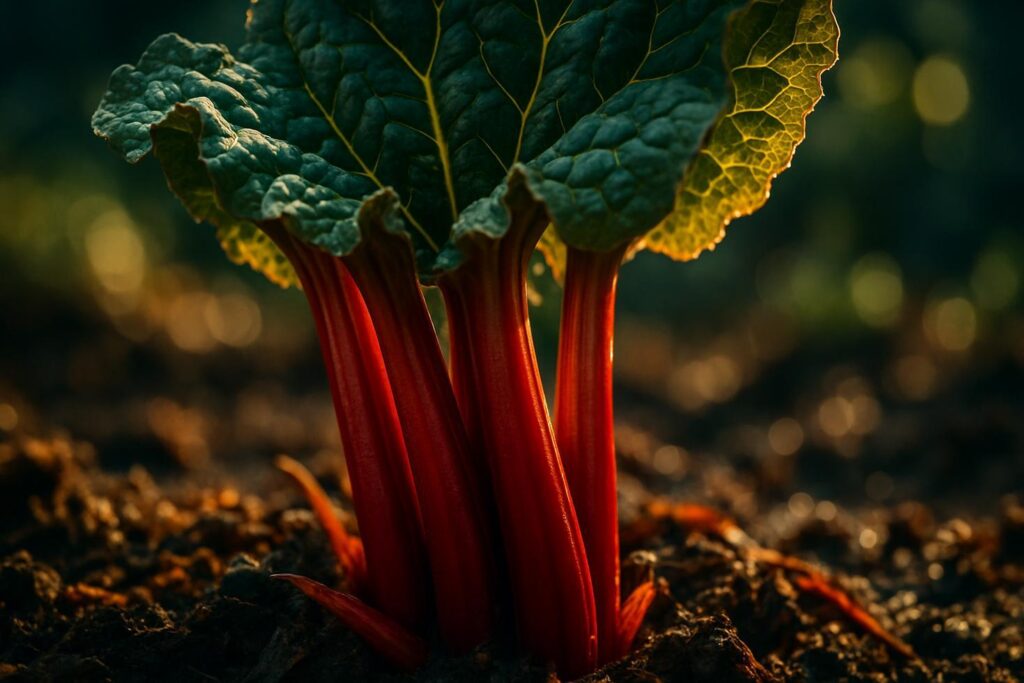
Rhubarb leaves carry oxalic acid that makes them genuinely unsafe to eat — yet the stalks frozen in spring last a full 12 months.
Rhubarb stalks refrigerated without their leaves last 1 to 3 weeks, but frozen stalks hold for up to 12 months. That gap is striking enough on its own. What makes it more interesting is that the leaves attached to those same stalks contain oxalic acid at concentrations high enough to cause real harm — kidney stress, calcium disruption, serious illness — which is why Michigan State University Extension explicitly instructs growers to trim and discard the leaves before handling stalks at all.
The two parts of the plant tell completely different stories. One is a chemical boundary the plant builds around itself. The other is quietly one of the most freezer-stable vegetables a home gardener can harvest.
Why Rhubarb Leaves Contain Oxalic Acid and Why That Matters
Oxalic acid accumulates in rhubarb leaves in concentrations that bind with calcium in the body, pulling it out of circulation. The result is not a mild stomach ache. It is the kind of physiological disruption — kidney stress included — that multiple university extension sources treat as a genuine safety concern, not a folk warning.
oxalic acid binding to circulating calcium is the mechanism behind that harm. The plant produces this compound as part of its own biology, not as an accident. The stalk, by contrast, contains far lower concentrations and is the part that has been cultivated for eating for centuries.
How Rhubarb Stalk Storage Duration Changes by Method
The numbers across preservation methods are worth laying out directly. Refrigerated stalks with leaves removed last 1 to 3 weeks under typical conditions, or as few as 1 to 2 weeks in some guides. SDSU Extension specifies that optimal cold storage requires temperatures at 32°F and relative humidity between 95 and 100%.
Freezing changes the math entirely. Blanching for 60 seconds before freezing is one documented preparation step. After that, a single spring harvest frozen at peak holds 8 to 12 months by most verified sources, with the upper range confirmed at 12 months. Drying is a third option — Plantura Magazin notes drying at 50 to 60°C for 8 to 12 hours — though freezing remains the most widely documented method for long-term preservation.
One spring cutting, managed correctly, carries through an entire year.
Closing
The rhubarb plant packages danger and value side by side, growing from the same root. The leaf’s oxalic acid is real enough that every credible extension source treats removal as non-negotiable. The stalk, once separated and frozen, outlasts nearly every other fresh garden vegetable in the freezer.
That contrast — hazard and harvest, inches apart — is the most honest thing the plant has to say.
Frequently Asked Questions
Are rhubarb leaves poisonous to humans?
Yes. Rhubarb leaves contain oxalic acid at concentrations that can bind calcium and cause kidney stress. Michigan State University Extension advises trimming and discarding them before handling stalks.
How long do rhubarb stalks last in the freezer?
Frozen rhubarb stalks last 8 to 12 months, with sources confirming up to 12 months when properly prepared and sealed.
What is the best way to store rhubarb stalks short-term?
SDSU Extension recommends refrigerating stalks at 32°F with 95 to 100% relative humidity, which extends freshness to 1 to 3 weeks.
Can rhubarb stalks be stored upright in water?
Yes. Storing trimmed stalks upright in water, similar to cut flowers, holds them for approximately 5 to 7 days.