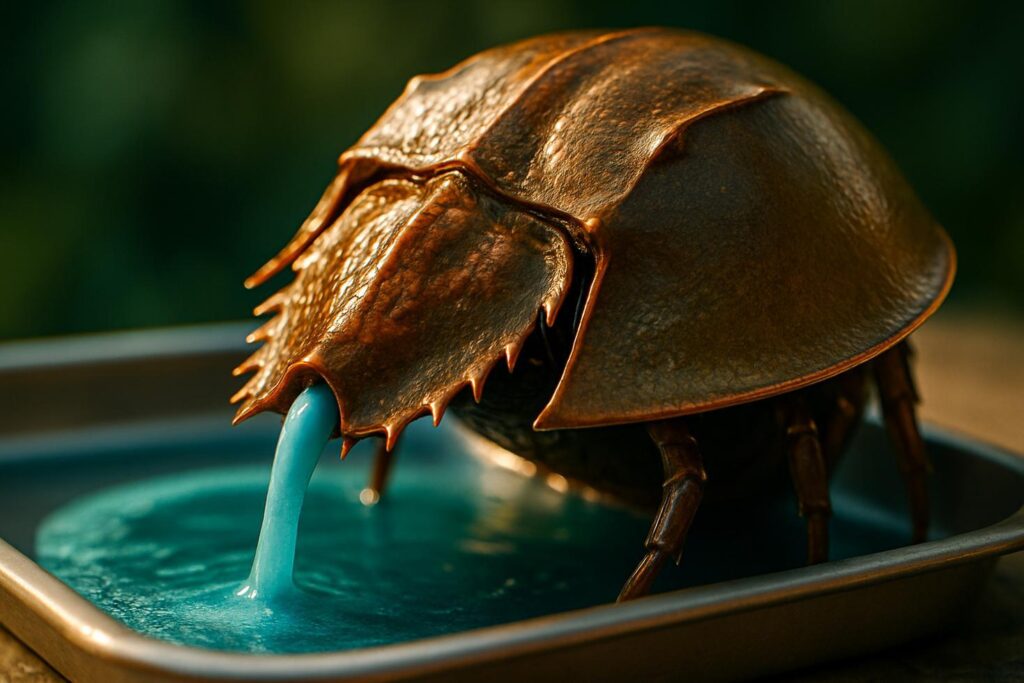
One drop of bacterial toxin dissolved across 20 Olympic swimming pools — horseshoe crab blood cells find it anyway, clotting around it in 45 minutes.
Horseshoe crab blood cells can detect bacterial endotoxin at one part per trillion, and that sensitivity has made them the global standard for screening injectable drugs and vaccines since the 1970s. The animal itself has been running this same immune routine for roughly 450 million years. What started as coastal survival chemistry became one of the most consequential quality-control tools in modern medicine.
The cells responsible are called amebocytes. They circulate in blood that runs blue — copper-based hemocyanin carries oxygen here, not iron-based hemoglobin. When an amebocyte brushes against endotoxin, specifically lipopolysaccharide from Gram-negative bacteria like E. coli, a cascade launches immediately.
How the Clotting Cascade Works Inside Horseshoe Crab Amebocytes
When an amebocyte detects endotoxin, it activates factor C, which triggers factor B, which activates a clotting enzyme. That enzyme converts coagulogen into coagulin — an insoluble gel that physically seals pathogens at the site of exposure. A parallel pathway, triggered through factor G, responds to beta-(1,3)-glucan, a signature molecule associated with fungal cell walls.
The gel forms at the injury site itself, isolating the threat before it can spread through the crab’s circulatory system. This mechanism likely evolved in microbe-rich coastal sediments, where bacterial exposure is constant and an immune response that hesitates is an immune response that fails.
How the LAL Assay Translated This Biology Into a Pharmaceutical Safety Test
Scientists extracted and lysed horseshoe crab amebocytes to create the Limulus amebocyte lysate, or LAL. When LAL contacts endotoxin in a drug sample, it runs the same clotting reaction — detectable in a lab setting within about 45 minutes.
The assay became the regulatory standard for screening intravenous fluids, injectable medications, vaccines, surgical implants, and medical devices. It detects endotoxin, the toxic component shed by Gram-negative bacteria, because endotoxin can trigger severe fever and inflammatory reactions in humans even when no live bacteria remain.
No synthetic alternative had matched this sensitivity across all applications when the test was first adopted, and the LAL assay remained the dominant method decades after its introduction.
An animal already old when dinosaurs appeared turns out to hold a chemistry that human engineers had not yet invented. The clotting cascade in a horseshoe crab’s blood is not elaborate — it is fast, direct, and it works. That combination proved hard to improve on.
Frequently Asked Questions
What does the LAL test actually detect?
It detects endotoxin — specifically lipopolysaccharide from Gram-negative bacteria — not bacteria themselves.
How sensitive is the LAL assay?
It can detect endotoxin at one part per trillion and return a result in approximately 45 minutes.
When did the LAL assay become a standard pharmaceutical test?
It was developed in the 1960s and became widely used for drug and vaccine screening during the 1970s.
Why is horseshoe crab blood blue?
It contains hemocyanin, a copper-based molecule that carries oxygen — unlike the iron-based hemoglobin in human blood.