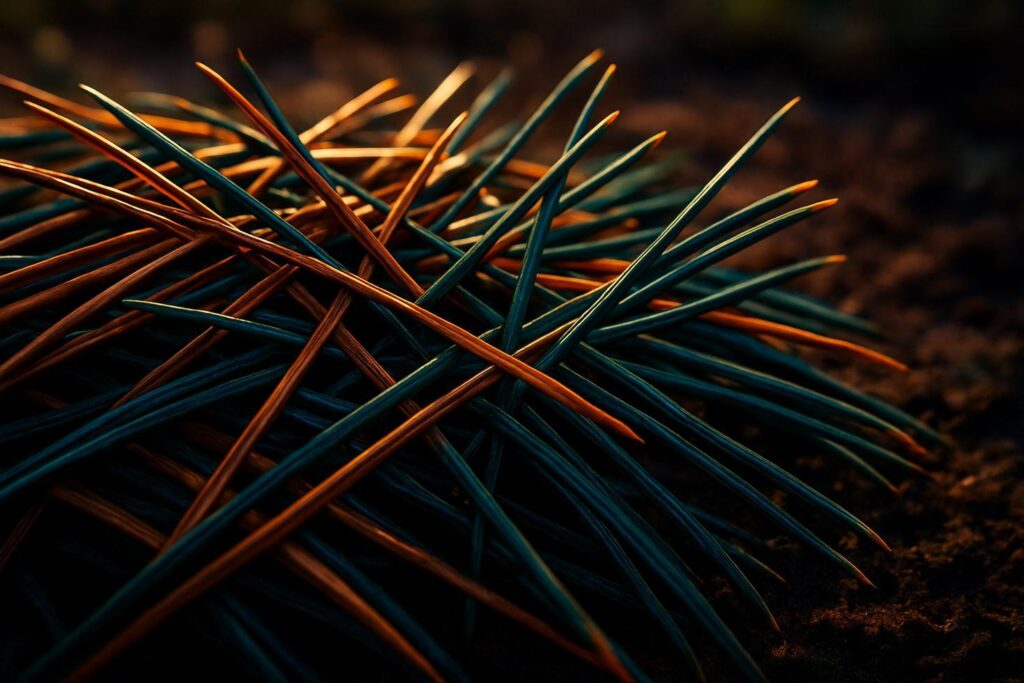
Pine needles interlock into a porous lattice that holds 75–85% void space when dry — and that structure persists for 8–12 months while an oak leaf dissolves in weeks.
Pine needles don’t simply pile up after they fall — they weave into an interlocking mat that stays loose, porous, and structurally stable far longer than most leaf litter. That distinction matters for everything living beneath the surface. The same fibers that make the mat resist collapse also make it resist decomposition, and both properties trace back to a single material: lignin.
A maple leaf hits the ground already on borrowed time. Bacteria and fungi break it down within 4 to 6 weeks. A pine needle, dense with waxy, lignin-rich fiber, is still holding its position in the mat 8 to 12 months later.
How Pine Needle Interlocking Creates a Stable Mat Structure
Each needle is long, thin, and slightly curved. When needles accumulate, those shapes catch and cross each other rather than stacking flat. The result is a three-dimensional lattice with air corridors running through it.
Extension guidance from University of Washington describes pine needles staying loose and light rather than forming an impenetrable crust — unlike broad leaves, which mat down and seal the surface. Those open corridors let rainfall infiltrate instead of sheeting off, and they funnel oxygen down to the soil organisms that depend on it.
Peer-reviewed soil conservation literature confirms that pine straw on the forest floor protects against erosion, conserves moisture, provides organic matter, and moderates soil temperature — all functions that depend on the mat staying porous rather than collapsing.
Why Lignin Makes Pine Needle Mats Decompose So Slowly
The same structure that holds the mat open also slows its breakdown. Pine needles are dense with lignin, a complex polymer that bacteria and fungi struggle to disassemble quickly.
Most deciduous leaves carry far less lignin. That’s why lignin content drives the decomposition gap — ordinary leaves are gone before the mat they fell into has even begun to loosen. The pine needle’s waxy surface adds another layer of resistance, limiting the moisture contact that microbial activity requires.
University of New Hampshire Extension notes that pine needles are quite stable and slow to break down, making them durable as a mulch material well beyond a single season.
Closing
What looks like passive litter is actually a functioning system — porous enough to breathe, stable enough to anchor, and slow enough to outlast multiple growing seasons. The needle’s lignin didn’t evolve to make a useful mulch. It just does.
Frequently Asked Questions
Do pine needles make soil acidic?
No. University of New Hampshire Extension states a 2 to 3 inch layer of pine needle mulch will not change soil pH enough to measure.
How long does a pine needle mat last?
Pine needles persist 8 to 12 months before breaking down significantly, compared to 4 to 6 weeks for most deciduous leaves.
Why don’t pine needle mats compact like leaf piles?
Their long, curved shape causes needles to cross and interlock rather than stack flat, maintaining air space throughout the mat.
Does a pine needle mat help soil health?
Yes. Peer-reviewed soil conservation research confirms pine straw protects against erosion, conserves moisture, and moderates soil temperature.