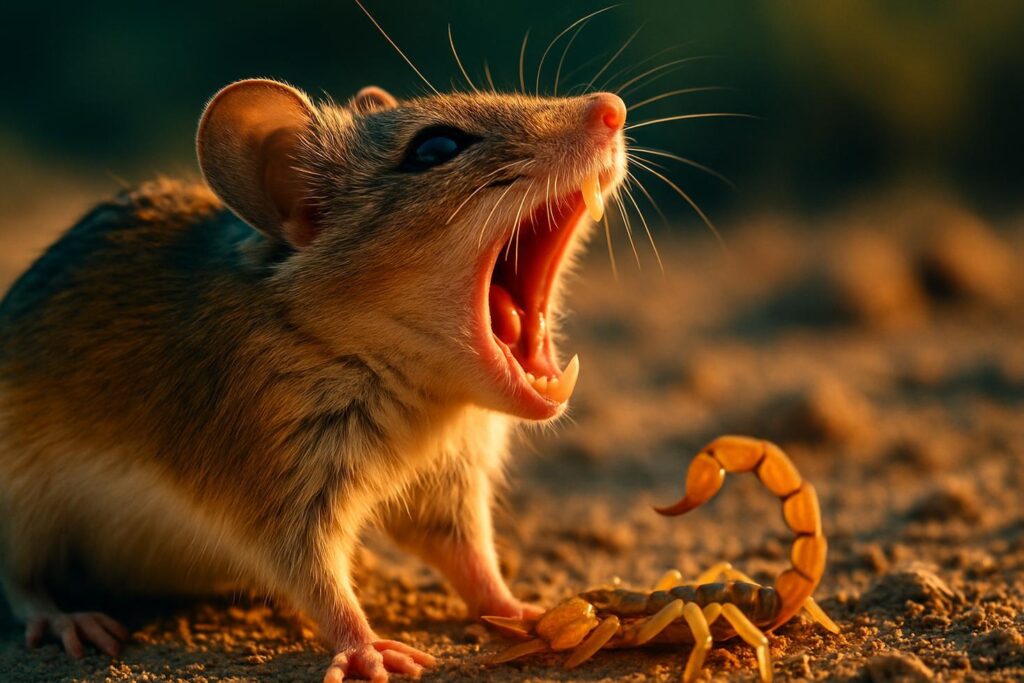
The Arizona bark scorpion is one of North America’s most venomous — yet one amino acid swap inside a single sodium channel turns its sting into temporary numbness for the grasshopper mouse.
The Southern grasshopper mouse (Onychomys torridus) has evolved a pain pathway that repurposes Arizona bark scorpion venom as a transient analgesic rather than an alarm signal. That outcome traces to a single protein in the mouse’s pain-sensing neurons — the sodium channel Nav1.8. When scorpion toxins bind to that channel, they suppress the pain signal before it travels toward the brain.
This is not immunity in the traditional sense. The mouse can still feel pain from other sources. The analgesic effect is specific to this venom-triggered pathway, which makes the mechanism far more interesting than a blanket resistance.
What the Nav1.8 Sodium Channel Actually Does During a Sting
In most small mammals, bark scorpion venom triggers the normal pain cascade through ion channels in nociceptors. In the grasshopper mouse, the venom binds to Nav1.8 — but the binding suppresses the channel rather than activating it. Venom binding silences the pain-transmitting channel instead of firing an alarm.
The glutamic acid residue is where that interaction happens. Swap it for glutamine in a lab setting, and the venom can no longer bind. The analgesic effect disappears completely, and the channel behaves like any other mammal’s.
The Howling Mouse That Hunts Scorpions
The grasshopper mouse is a genuine predator. It actively hunts and eats Arizona bark scorpions — a prey item most small mammals avoid entirely because the sting is behaviorally deterrent and painful enough to overwhelm them.
The mouse also produces a well-documented long-distance vocalization, standing on its hind legs with its nose pointed upward and emitting a piercing call. Recorded calls last 0.7 to 1.2 seconds, reach nearly 14,000 Hz, and can be heard up to 100 meters away. A 2017 peer-reviewed study in Proceedings of the Royal Society B found the species uses two distinct vocal mechanisms: airflow-induced tissue vibration for territorial calls, and a whistle mechanism for close-range ultrasonic communication. The howl is used in territorial advertisement, not as a confirmed post-hunt signal.
Closing
What makes this story scientifically durable is its specificity. One channel, one residue, one interaction — and the scorpion’s primary defense becomes chemically useless against this particular predator. That kind of precision is rare enough in evolutionary biology that researchers have pointed to this system as a potential model for understanding pain modulation more broadly. The scorpion didn’t get weaker. The mouse just rewired what the venom does when it arrives.
Frequently Asked Questions
Does Arizona bark scorpion venom actually stop hurting the grasshopper mouse?
Yes — the venom binds to Nav1.8 sodium channels in the mouse’s pain-sensing neurons and blocks pain transmission, producing a temporary analgesic effect specific to that pathway.
What is the one amino acid difference that matters?
A glutamic acid residue in Nav1.8 is the binding site; replacing it with glutamine in lab tests eliminated the venom’s analgesic effect entirely.
Can the grasshopper mouse still feel pain at all?
Yes. The altered response is pathway-specific — the mouse remains sensitive to pain from other sources.
Why does the grasshopper mouse howl?
It produces territorial vocalizations lasting 0.7 to 1.2 seconds, audible up to 100 meters away, used in territorial advertisement and intraspecific communication — not as a confirmed hunting signal.