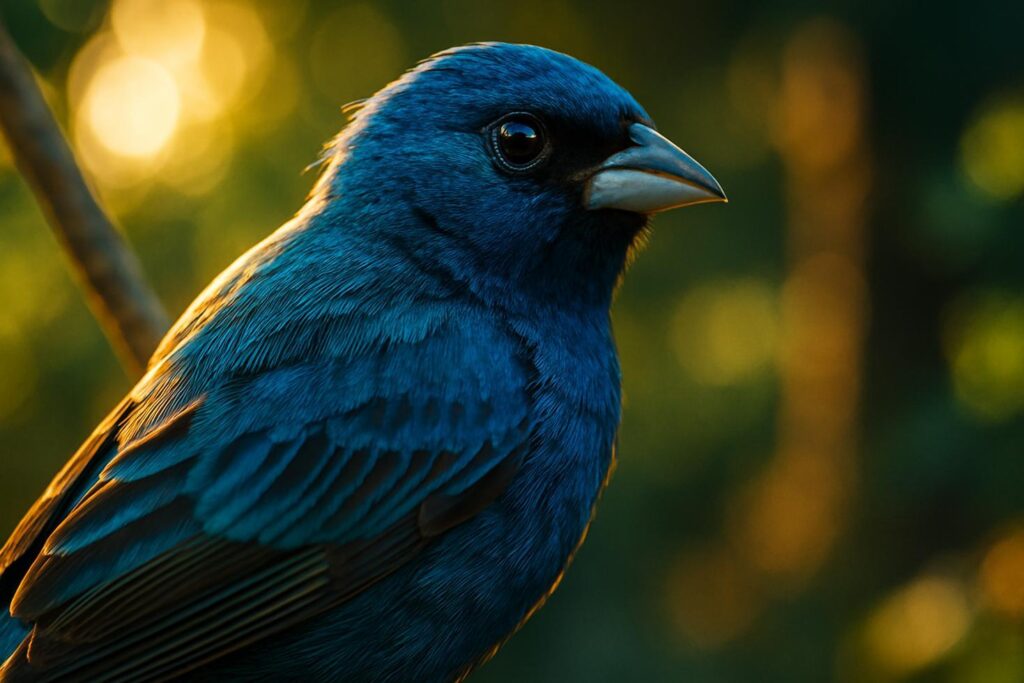
Male indigo buntings carry zero blue pigment — feather microstructure bends light to flash azure, then vanishes to pure black when the angle shifts.
The male indigo bunting produces no blue pigment anywhere in his feathers. That saturated, electric blue is generated entirely by microscopic structures in the feather keratin that scatter light — and it disappears completely when the light angle changes.
There is something quietly astonishing about watching this happen in real time. The same bird, the same feathers, the same perch — and a slight shift in the sun’s position turns a scrap of living sky into something that looks nearly black. No pigment anywhere in that feather is responsible. Only architecture.
How Feather Microstructure Creates Structural Color in Indigo Buntings
The feather keratin in a male indigo bunting is arranged at a nanoscale level that reflects and scatters blue wavelengths back toward the observer. Melanin in the same feathers absorbs the remaining wavelengths, preventing them from bouncing back. The result is blue — but only when light strikes the feather at the right angle.
Melanin absorbs competing wavelengths so scattered blue light is all that returns. Cut the light or shift the viewing angle, and no wavelengths scatter back at all. The bird reads as black.
Why the Indigo Bunting’s Color Changes With the Season
Structural color explains the summer display, but feather shape explains the winter disappearance. In fall, males molt into fresh plumage with brown edges covering the microstructured feather tips. Cornell Lab documents this transition: the breeding-season blue gives way to a brown-edged appearance through fall and winter, then returns as breeding season arrives in spring.
Brown feather edges physically block the light-scattering surface until wear exposes it again. The underlying microstructure hasn’t changed — just its access to light.
Closing
The indigo bunting is a useful reminder that color in nature isn’t always stored the way paint is stored in a can. Sometimes it only exists in the meeting between a surface and a photon. Tilt the bird. Lose the blue. That’s not a trick — that’s the whole mechanism.
Frequently Asked Questions
Does the male indigo bunting have any blue pigment at all?
No. Multiple ornithology sources confirm that the blue appearance is structural, not chemical — no blue pigment is produced or stored in the feathers.
Why does an indigo bunting sometimes look black?
Structural color depends entirely on viewing angle and light direction. When light doesn’t strike the feather microstructure at the right angle, no blue wavelengths scatter back, and the bird appears nearly black.
Do female indigo buntings have the same feather structure?
Females are brown and lack the breeding plumage of males. The structural coloration described here applies specifically to adult males during breeding season.
Is the indigo bunting’s color really the same as the sky’s blue?
The mechanism is comparable — light scattering that returns only blue wavelengths — though the exact nanostructure differs from atmospheric scattering.
[RMQ6E]