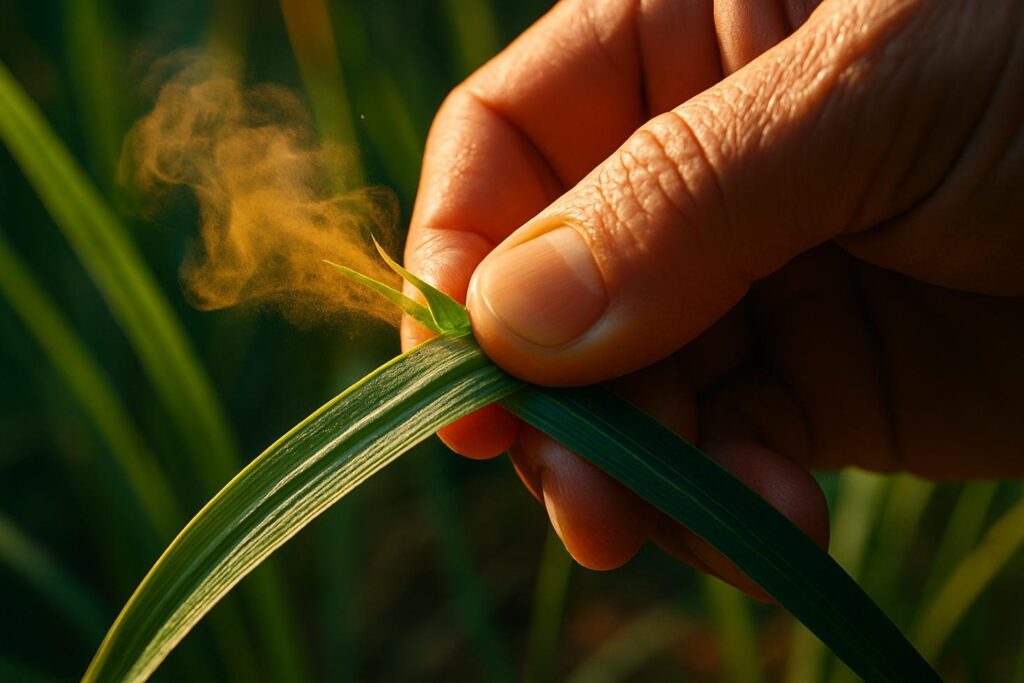
Citronella grass releases nearly zero repellent from intact leaves — bruising breaks cell walls, flooding the air with citronellal that disrupts a mosquito’s sense of smell within a 30-minute to 2-hour window before fully evaporating.
An intact citronella grass plant releases almost no repellent into the surrounding air. The oils stay locked inside leaf tissue until physical damage — crushing or bruising — breaks those cell walls and releases volatile compounds into the air. That single mechanical event is what makes the plant’s chemistry biologically relevant to mosquitoes.
The effect is olfactory, not toxic. Citronella oil repels rather than kills. Its main constituents — citronellal (32–45% of oil), geraniol (18–25%), and citronellol (10–20%) — are detected by a mosquito’s olfactory system and trigger avoidance behavior while masking the host scents the insect uses to navigate.
How Bruising Citronella Grass Releases Its Active Compounds
The repellency depends entirely on volatiles reaching the air. Crushing or bruising the leaf ruptures plant tissue, releasing citronellal and its companion compounds into the surrounding space. The intact leaf itself offers no meaningful airborne concentration.
Once released, citronellal disrupts mosquito olfactory signaling by interfering with the chemical cues — such as lactic acid and carbon dioxide — that mosquitoes use to track warm-blooded hosts. The result resembles signal interference: the navigational information the insect needs simply becomes unavailable.
Why Citronella Protection Fades So Quickly
High volatility is both the mechanism and the limitation. The same property that allows citronellal to flood the air after bruising also causes it to disperse and thin out rapidly. Experimental protection times vary significantly by species and formulation: against Aedes aegypti, citronella grass oil averaged about 55 minutes in one study; against Culex quinquefasciatus, the same oil in an olive oil base extended protection to 165 minutes.
Fixatives measurably slow this evaporation. Adding 1% vanillin to a 5% citronellal derivative formulation increased protection time in controlled testing. A separate finding showed that a 6:4:1 mixture of citral, myrcene, and citronellal produced stronger inhibition of mosquito host-seeking behavior than citronella oil alone, suggesting the compound ratio matters as much as concentration.
What the 95% Repellency Figure Actually Means
That result — 95% repellency at 0.1% citronellal — comes from a controlled experimental dose of 3.33 μg/cm² applied to skin. The percentage reflects performance under those specific conditions, not from a crushed leaf held nearby. Oil composition also shifts with grass variety, climate, soil, and distillation method, which explains why repellency percentages and protection windows vary substantially across published studies.
The chemistry is consistent. The delivery context is not.
Citronella grass carries real, measurable repellent chemistry — the mechanism is verified, the compounds are identified, and the olfactory disruption is well-documented. The constraint is time. Every release after bruising is brief, concentration-dependent, and temporary. The plant does not run out of oil. It runs out of air.
Frequently Asked Questions
Does an unbruised citronella plant repel mosquitoes?
No. Intact leaves release negligible volatile compounds into the air; bruising or crushing is required to expose the repellent oils.
How long does citronella grass oil actually repel mosquitoes?
Protection ranges from about 30 minutes to 2 hours depending on formulation, conditions, and mosquito species.
What is the active compound in citronella grass oil?
Citronellal is the primary repellent constituent, making up 32–45% of the oil, alongside geraniol and citronellol.
Can anything extend how long citronella oil works?
Yes — adding 1% vanillin to a citronellal formulation has been shown to increase protection time in controlled studies.