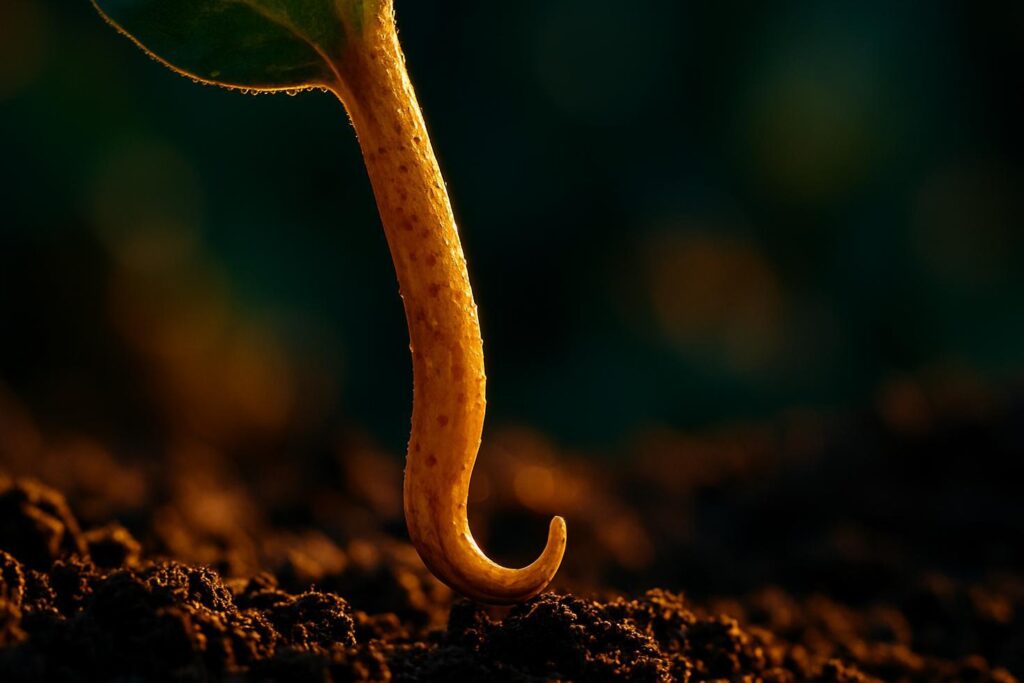
A peanut flower opens at sunrise and withers by that same afternoon. In the 8–12 days that follow, a specialized stalk drills 1–2 inches into the soil — and the pod that forms down there never sees daylight. Only 1 in 5 flowers makes it that far.
A peanut pod never exists above the soil surface — it forms entirely underground, even though the flower that started it bloomed in open air. The plant produces a structure called a gynophore, or peg, which elongates downward after fertilization and pushes the developing embryo into the ground. What ends up in a jar of peanut butter began its life in a flower smaller than a fingernail, in a process that takes weeks and mostly fails.
The flower itself is a one-day event. It opens near sunrise, self-fertilizes within hours, and wilts before evening. That brevity makes what follows even more striking.
Quick facts:
– Peanut flowers first appear 25–40 days after planting, depending on cultivar
– The peg becomes visible roughly one week after fertilization
– Pegs penetrate soil 8–12 days after pollination, reaching 1–2 inches deep
– Pods reach full size about 3–4 weeks after peg burial
– Only 15–20% of flowers successfully produce a pod
What the Peanut Peg Actually Does and How It Works
The peg is the elongated ovary stalk — the gynophore — growing from just above where the flower attached to the stem. Positive gravitropism drives the peg downward, meaning the tip grows toward gravity rather than away from it, the opposite of how most shoots behave.
Once the tip contacts soil, it continues pushing downward until it reaches roughly 1–2 inches of depth under typical field conditions. Darkness is not an obstacle; it is a requirement. Pod development does not occur in light. The embryo needs soil pressure, moisture, and the absence of light to trigger normal pod fill.
Why the 15–20 Percent Pod Set Rate Matters
A peanut plant is indeterminate, meaning it keeps producing new flowers from about 25 days after planting all the way past 100 days in some cultivars. A single plant in a favorable mid-spring planting can generate hundreds of flowers across that window.
But most pegs never reach productive soil depth. Some flowers produce no peg at all. Others send a peg that stalls. The 15–20 percent figure verified by GRDC agronomic data means roughly four out of every five flowers contribute nothing to the harvest. Every peanut in a finished product represents one of the successful minority.
Closing
The peanut plant flowers generously and succeeds sparingly. A process that starts in morning sunlight, bends underground within two weeks, and finishes in total darkness for another month — just to fill one pod — runs simultaneously across dozens of attempts per plant, most of which quietly end nowhere.
The most well-traveled snack never moved an inch.
FAQ: Peanut Underground Pod Formation
Why do peanuts grow underground if the flowers are above ground?
After fertilization, the ovary stalk (gynophore or peg) grows downward through positive gravitropism and pushes the embryo into the soil, where pod development is triggered by darkness, moisture, and soil pressure.
How long does it take for a peanut peg to reach the soil?
The peg becomes visible about one week after fertilization and typically penetrates the soil 8–12 days after pollination, reaching 1–2 inches of depth.
What percentage of peanut flowers actually produce a pod?
About 15–20 percent of flowers successfully complete peg burial and produce a pod, according to GRDC agronomic data.
Can a peanut pod develop above ground?
No. Pod development requires darkness, soil moisture, and physical pressure — conditions only found underground. Pegs that fail to reach the soil do not produce pods.
Sources:
GRDC GrowNote Peanuts North
Clemson Cooperative Extension
USDA ARS National Peanut Research Laboratory
Peanut Science (peanutscience.com)