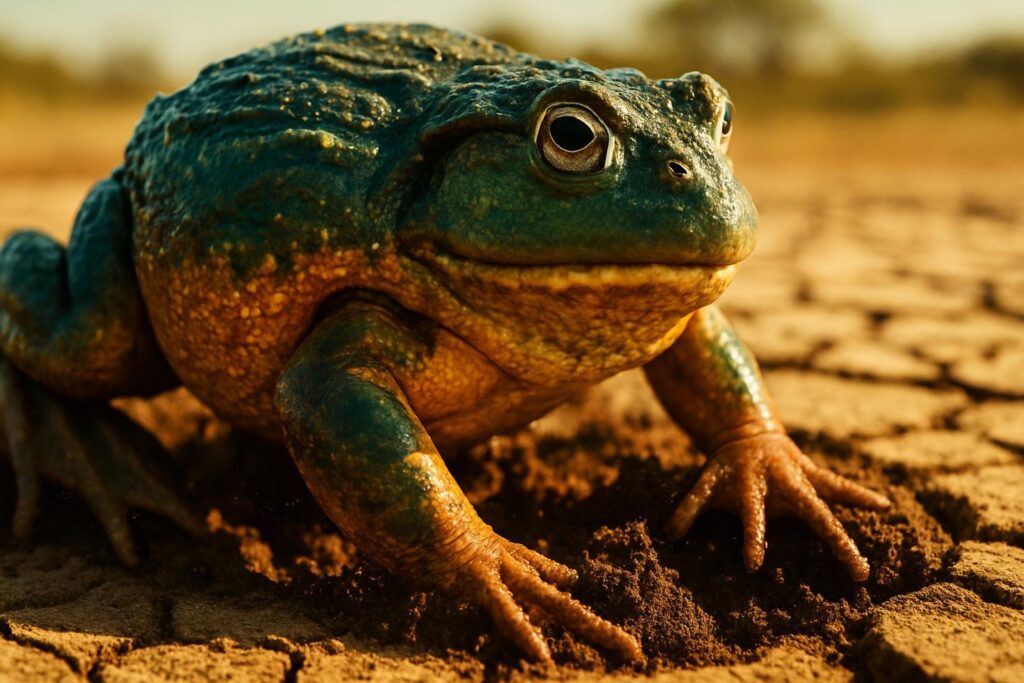
One male. One dry season. A hand-dug canal — and thousands of tadpoles riding the current to deeper water.
The male African bullfrog (Pyxicephalus adspersus) digs a channel through the mud to connect a shrinking pool to a larger water source, allowing his tadpoles to drift to safety before the shallows disappear entirely. That single act reshapes the physical landscape. It is also something no other frog on Earth has been documented doing.
Most amphibians mate and vanish. This one stays for the entire arc — from eggs to legs — and physically alters the ground when conditions turn against him.
How the African Bullfrog Digs a Rescue Canal
When the shallow water begins to recede, the male moves to the narrowing edge and starts excavating. He uses his hind legs and head to push through mud, carving a channel that connects the failing pool to deeper water nearby. The tadpoles then ride the current through the new passage and continue developing in a stable environment.
This digging ability is not accidental. African bullfrogs excavate underground burrows using a hardened metatarsal tubercle on their hind feet — a built-in digging tool that makes them unusually capable of moving soil compared to most frogs.
What Makes This Parental Care Unusual Among Frogs
The male’s involvement begins at egg deposition. Eggs are laid in shallow temporary pools around larger ponds after heavy rainfall triggers breeding. The father guards those eggs for roughly 2 days until they hatch, then remains stationed at the pool as the tadpoles develop.
Guarding a few thousand tadpoles simultaneously is the scale of that commitment. He defends them against predators throughout — and research documents that he occasionally eats some of them himself, which makes this one of the more complicated pictures of parental care in the amphibian world.
He stays until the tadpoles fully metamorphose and leave the water. The season’s work ends only when there is nothing left to guard.
African Bullfrog Size and Why It Matters for This Behavior
Pyxicephalus adspersus is the largest frog in Africa. That body size matters here. A small frog cannot meaningfully redirect water or move significant volumes of mud. The African bullfrog’s mass gives the canal-digging behavior actual mechanical effect on the landscape.
Most frogs have no such leverage over their environment.
The African bullfrog does not wait for conditions to improve. He changes the conditions. That gap — between passive waiting and active landscape engineering — is what makes this animal genuinely remarkable. The mud he moves may be the smallest construction project in Africa and also the most consequential.
Frequently Asked Questions
What triggers an African bullfrog to dig a rescue canal?
The male digs a channel when the shallow temporary pool holding his tadpoles begins to dry, connecting it to a deeper, more stable water source nearby.
How long does a male African bullfrog guard his tadpoles?
He begins guarding eggs about 2 days before they hatch and remains with the tadpoles until they fully metamorphose.
Do African bullfrog fathers eat their own tadpoles?
Yes, documented cases of cannibalism occur while the male is guarding the brood, indicating the parental care is not purely altruistic.
Is the African bullfrog the only frog known to dig rescue canals?
Current research has not documented this canal-digging behavior in any other frog species.