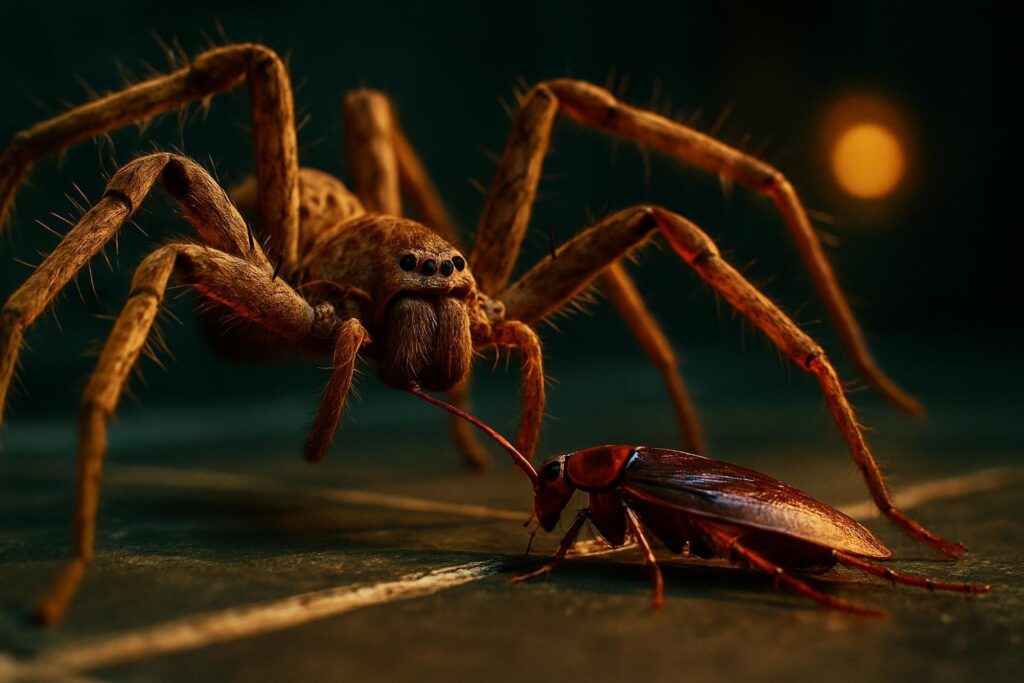
Eight legs, zero webs, and at least 9 documented prey species — a huntsman doesn’t wander inside randomly. It follows the insects already living there.
Huntsman spiders enter homes because their prey enters first. That single fact reframes the whole encounter. What looks like a random intruder flattened against the bathroom wall is actually the second act of a chain that started outdoors, with something smaller moving through the same gap an hour earlier.
These are wandering predators. No web, no silk geometry, no waiting. They detect movement through both vision and vibration sensing in their legs, and they hunt through the night on walls, ceilings, and floors without pausing to build anything.
How Huntsman Spiders Detect and Chase Indoor Prey
Huntsman spiders combine two sensory systems: their eyes for visual tracking and specialized leg receptors that pick up vibrations through surfaces. A cockroach crossing a tile floor produces both.
Once contact is made or proximity closes, the spider accelerates. They can spring-jump mid-run. Vibration sensing through the legs gives them effective coverage in the dark, where visual tracking alone would fail on a moving insect.
Which Household Pests a Huntsman Will Actually Hunt
The prey list is genuinely broad. Cockroaches appear most consistently across sources as a primary target. Moths, flies, silverfish, crickets, and mosquitoes are all documented. Caterpillars and other spiders are included. Small vertebrates — specifically skinks and geckos — show up occasionally.
That breadth reflects generalist predator strategy at work: the spider is not selective. It responds to movement and size cues, which means almost any invertebrate sharing the space is a candidate.
Why Removing Insect Populations Removes the Huntsman Too
Pest-control sources note a consistent pattern: when the indoor insect population drops, huntsman spiders move on. The prey chain pulls them in, and the same chain’s absence pushes them out.
This makes the spider a trailing indicator. Its presence signals that something else already established itself indoors first. Reducing lights that attract moths and flies at entry points addresses the base of that chain rather than the spider at the end of it.
Huntsman spiders are shy by nature and avoid confrontation. Bites are associated with being cornered or handled, not with any hunting behavior directed at people.
The spider on the wall after midnight is not lost. It is working. The insects that drew it inside were there first, and by dawn, some of them won’t be. Most households run this nightshift without ever noticing the worker running it.
Frequently Asked Questions
Do huntsman spiders come inside on purpose?
Their indoor presence is linked to prey availability and shelter — they follow insects through gaps rather than entering randomly.
What insects does a huntsman spider eat indoors?
Documented prey includes cockroaches, moths, flies, silverfish, crickets, mosquitoes, caterpillars, other spiders, and occasionally small lizards like skinks and geckos.
Will a huntsman spider leave on its own?
Pest-control sources note that huntsman spiders move on when the indoor insect population declines, because the food source that drew them in is gone.
Are huntsman spiders dangerous inside a house?
They are generally shy and avoid people. Bites occur when the spider is trapped, handled, or cornered — not during normal indoor hunting activity.