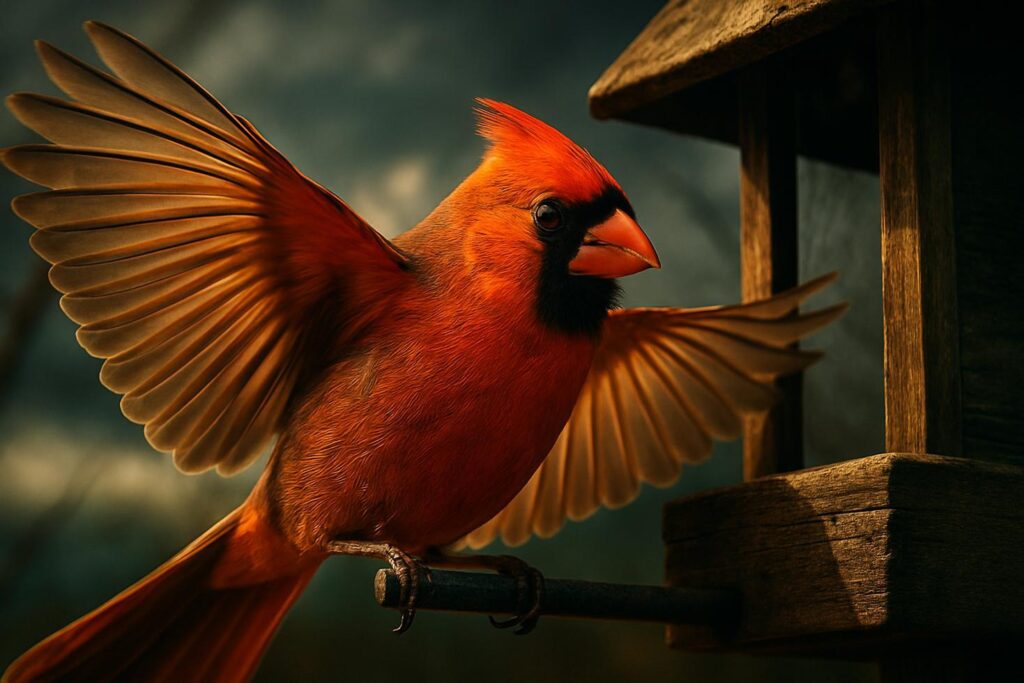
Cardinals and finches detect pressure shifts as small as 10–20 mm H₂O — through a fluid-filled middle-ear chamber — up to 24 hours before rain arrives. The storm hasn’t formed. The bird already knows.
Birds crowding a feeder before a storm are not reacting to clouds or wind — they are responding to a pressure drop detected hours earlier through a specialized structure in the middle ear called the paratympanic organ. A peer-reviewed review identifies this fluid-filled chamber as the most likely organ transmitting barometric pressure information to a bird’s brain. Researchers have tracked the resulting feeding surge beginning 12 to 24 hours before rain arrives.
What makes this striking is the scale of the trigger. The pressure shift involved is vanishingly small — and the response it produces is immediate and visible.
How the Paratympanic Organ Detects Pressure Changes
When atmospheric pressure drops, it deforms the tympanic membrane. That deformation moves fluid inside the PTO vesicle, which stimulates mechanosensory hair cells lining the chamber. Those hair cells send the signal onward to the brain.
Fluid movement across mechanosensory hair cells is the same basic mechanism the inner ear uses to detect sound and balance. Here, it is reading weather instead.
The sensitivity documented in the literature is 10–20 mm H₂O — a shift equivalent to moving up or down roughly 10 to 20 meters in altitude. That is smaller than the pressure change between two floors of a typical building.
What the Sparrow Experiment Actually Showed
The clearest experimental evidence in the available sources involves white-throated sparrows, not cardinals or finches. When researchers artificially lowered barometric pressure by as little as 10 mm in a controlled chamber, sparrows increased feeding behavior under low-pressure conditions and spent more time preening and hopping under normal pressure.
A separate observational account recorded finches feeding intensely on a clear day. Barometric pressure reached its low point at noon that day, then rose nearly 30 mm by midnight the following day — with sunny skies but a 30-degree temperature drop. The birds tracked pressure, not cloud cover.
The 12–24 hour behavioral window is supported across sources, though the evidence is stronger for the pressure-sensing mechanism itself than for any single species as a reliable storm predictor.
What “Feeder Crowding” Actually Signals
The behavior is front-loading. A bird’s energy reserves are thin, and sustained rain cuts foraging time. When the PTO registers a meaningful pressure drop, feeding increases — not in panic, but in the methodical way any animal responds to a resource about to become scarce.
Cardinals and finches at a feeder before a storm are doing something ancient and efficient. They are not forecasting. They are responding to a signal their anatomy was built to receive.
The storm may still be forming somewhere over the horizon. The pressure wave from it has already arrived.
Frequently Asked Questions
What is the paratympanic organ in birds?
It is a fluid-filled mechanosensory chamber in the middle ear that detects changes in atmospheric pressure by translating membrane deformation into hair-cell stimulation.
How small a pressure change can birds detect?
Peer-reviewed research documents sensitivity to shifts as small as 10–20 mm H₂O, equivalent to an altitude change of roughly 10–20 meters.
How far in advance do birds change behavior before a storm?
Researchers have tracked increased feeding beginning 12 to 24 hours before rain arrives.
Is this proven specifically for cardinals and finches?
The strongest experimental evidence is from white-throated sparrows. The pressure-sensing mechanism is documented broadly in birds; the cardinal and finch association is observational, not yet experimentally controlled.