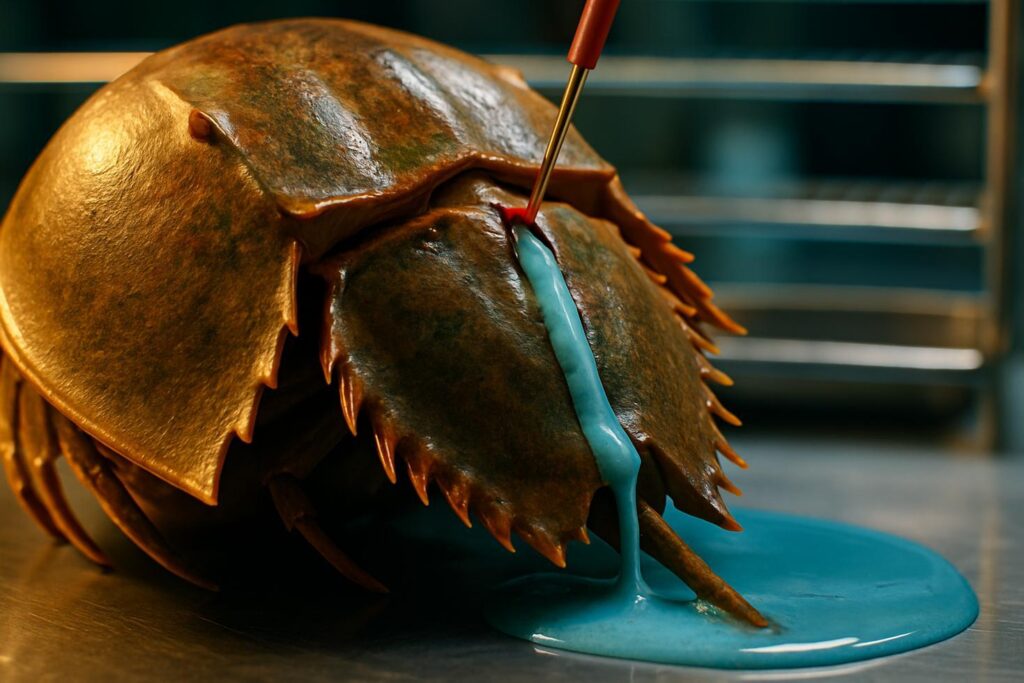
500,000 crabs bled each year — females bleed during peak spawning stress — and roughly 130,000 die before returning to the water.
Atlantic horseshoe crab blood contains a compound called LAL that detects bacterial endotoxins at one part per trillion, a sensitivity no laboratory test could match before the 1970s. That single biological fact turned a prehistoric marine animal into the backbone of pharmaceutical safety testing. Every injectable drug, every vaccine, every IV bag cleared for human use passes through this chemistry first.
The extraction happens at scale. Between 500,000 and 600,000 Limulus polyphemus are captured along the U.S. East Coast each year for LAL production. Around 87% are returned to the ocean. The problem is what happens to a significant share of those returned animals.
What LAL Actually Does Inside the Crab’s Blood
Horseshoe crab blood lacks hemoglobin. It carries hemocyanin, and within it, specialized cells called amebocytes. When those amebocytes encounter bacterial endotoxins, they release a clotting cascade — LAL, or Limulus Amebocyte Lysate. The clotting mechanism triggers at one part per trillion, roughly equivalent to detecting a single dissolved grain of salt in an Olympic pool. No synthetic alternative had matched that threshold at commercial scale when the FDA standardized the test in the 1970s.
Why Female Horseshoe Crabs Bear the Highest Biological Cost
Mortality rates are not uniform. A 2009 Massachusetts Division of Marine Fisheries study found 22% mortality for females returned immediately after bleeding and 30% for females held overnight. Males under commercial conditions showed 5–15%. The timing compounds the problem. Females are captured during spawning season — the annual window of maximum physiological stress — when their bodies are already mobilizing energy for egg production. Studies summarized in NIH/PMC reviews show that bled females demonstrate reduced return-to-spawn rates, disorientation, and depressed activity for several weeks post-bleed. The reproductive loss is real, though the precise magnitude varies by study.
How Bleeding Pressure Fits Into the Broader Population Picture
ASMFC applies a 15% assumed mortality rate in its management models, yielding an estimated 130,000 crabs killed annually by the bleeding process alone. That figure is additive. Horseshoe crab populations also face commercial bait harvest, habitat loss, and climate-related disruption. No single pressure drives the trend. But biomedical bleeding adds a measurable mortality increment to wild populations that are already managed under strict conservation review.
A synthetic alternative — recombinant Factor C, or rFC — has demonstrated functional equivalency in several pharmaceutical applications. It has not replaced LAL harvest at scale.
The oldest animal in the modern pharmacy costs more than a blood draw.
Frequently Asked Questions
What is LAL and why does it come from horseshoe crabs?
LAL is a clotting agent found in horseshoe crab amebocyte cells that reacts to bacterial endotoxins; no comparable synthetic test existed when the FDA adopted it as the safety standard in the 1970s.
How many horseshoe crabs die from bleeding each year?
Estimates put the figure at roughly 130,000 annually, derived from 500,000–600,000 bled and a 15–30% mortality range depending on sex and handling duration.
Does bleeding affect horseshoe crab reproduction?
Yes. Studies show bled females are less likely to return to spawning beaches and exhibit reduced activity for weeks post-bleed, though exact effect sizes vary by study.
Is there a synthetic replacement for LAL?
Recombinant Factor C (rFC) works in some pharmaceutical testing contexts but has not displaced LAL harvesting at commercial scale as of current regulatory practice.