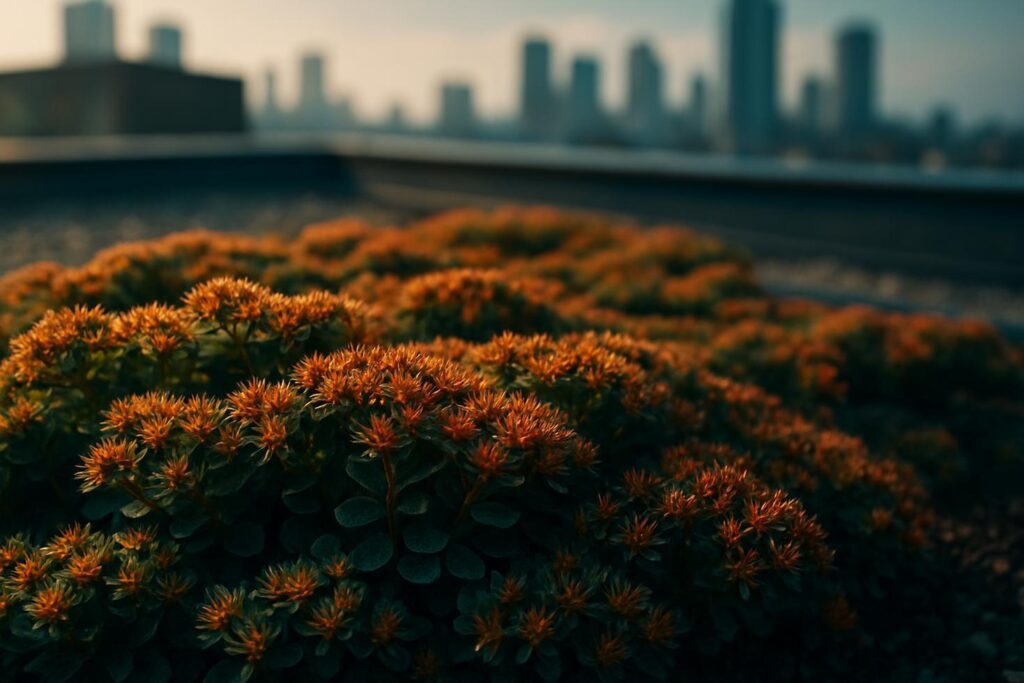
San Francisco’s 2017 mandate requires 15–30% of most new rooftops to be solar, living roof, or both — biodiversity written into municipal code, not a suggestion board.
San Francisco became the first major U.S. city to mandate solar and living roofs on most new construction when Planning Code Section 149 took effect January 1, 2017. That sentence sounds bureaucratic. What it describes is a city legally redefining what a rooftop is for.
The Better Roofs Ordinance (Ordinance 221-16) passed the Board of Supervisors in 2016 and became operative for all permit applications filed on or after January 1, 2017. Any new building with a gross floor area of 2,000 square feet or more and ten or fewer occupied floors falls under its reach.
What San Francisco’s Better Roofs Ordinance Actually Requires
The law sets a Better Roof Area of 15 to 30 percent of each qualifying rooftop. That area must be covered by solar panels, a living green roof, or a combination of both. Developers who choose the living roof path get a substitution rate: two square feet of living roof counts toward one square foot of the solar requirement. The full physical area of the living roof still counts for stormwater compliance, which is a separate calculation entirely.
Section 149 names three explicit purposes: renewable energy, stormwater management, and biodiversity. All three appear in the municipal code itself, not in a press release.
How Living Roofs Count Toward Stormwater and Habitat Goals
The stormwater rule rewards actual planted area. Even though a living roof earns only 0.5 credit per square foot toward the Better Roof Area threshold, every square foot counts for stormwater compliance. That split accounting reflects two distinct problems the ordinance is trying to solve simultaneously.
Biodiversity and habitat appear as stated goals in the code’s purpose language. Planning Commission materials describe living roofs as reducing urban heat island effects and providing habitat. The ordinance does not name specific species, require native plants, or reference the Pacific Flyway in its enforceable text — those details appear in promotional materials, not the legal code.
What the Ordinance Does Not Require
The flat claim that new buildings must cover 30 percent of their rooftop with a green roof is not accurate. The 30 percent figure is the ceiling for Better Roof Area, which includes solar. Living roofs are one compliance path, not the only one. The ordinance also does not mandate native or drought-tolerant plant species in its core enforceable text — that guidance exists elsewhere but is not a quantified legal requirement under Section 149.
The law took legislative effect in 2016. Compliance obligations, however, begin with permits filed in 2017. Those are different dates, and the distinction matters for any building permitted in that window.
San Francisco’s skyline has been accumulating legally mandated ecological infrastructure for eight years now. The mechanism is not inspiration — it is a substitution ratio and a permit checkbox.
Frequently Asked Questions
When did San Francisco’s Better Roofs Ordinance go into effect?
The ordinance passed in 2016 but became operative January 1, 2017, applying to permit applications filed on or after that date.
Does the ordinance require a green roof specifically?
No. It requires 15–30% of roof area to be Better Roof Area, which can be solar, living roof, or a combination of both.
Is biodiversity a legal requirement or just a goal?
Biodiversity is named as an explicit purpose in Planning Code Section 149, making it part of the ordinance’s stated legal intent.
Does the law require native plants on green roofs?
The core enforceable text of Section 149 does not specify native or drought-tolerant plants; that guidance appears in supplementary materials, not the legal code.