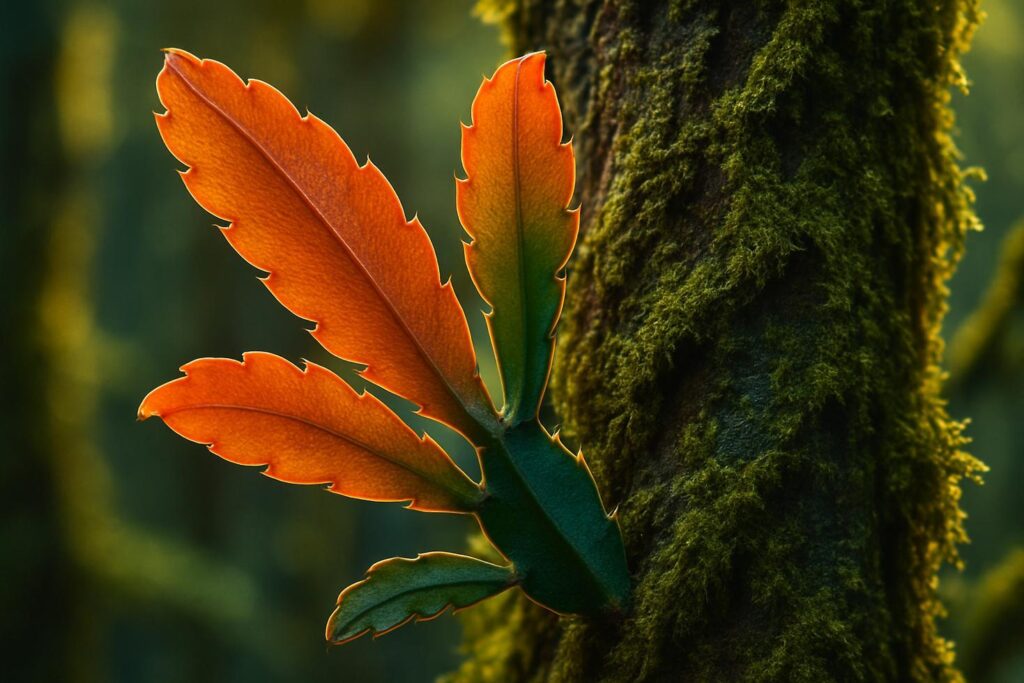
A plant that survives up to 17 inches of rain per month — built for cloud forest shade, not desert sun. That’s not a typo. That’s a rainforest cactus in disguise.
Schlumbergera, sold in nearly every garden center under the name “Christmas cactus,” is a cloud forest epiphyte native to the Atlantic Forest mountains of southeastern Brazil — not a desert plant. That distinction changes everything about how the plant behaves indoors. The wonder of it is that something labeled “cactus” turns out to be a neighbor of orchids and bromeliads, clinging to mossy tree bark in the mist.
Wild populations grow between 700 and 2,100 metres elevation in the Serra dos Órgãos and Serra do Mar ranges near Rio de Janeiro. At those altitudes, warm ocean air pushes upward, condenses, and produces near-constant cloud, humidity, and rainfall reaching up to approximately 17 inches per month during the wet season.
Quick facts:
– Native to Atlantic Forest cloud forests of southeastern Brazil, not desert habitats
– Grows as an epiphyte on tree bark and mossy rock faces, not in soil
– Receives up to ~17 inches of rain per month in the wet season; 2–3 inches even in the dry season
– Adapted to dappled, filtered canopy light — not direct sun
– Thrives between roughly 60–80 °F with high humidity
How Schlumbergera’s Epiphytic Roots Shape Its Light and Water Needs
In the wild, Schlumbergera anchors into bark crevices and pockets of decomposing organic matter on tree branches or shaded cliff faces. Its roots are built for grip and for absorbing water from rain, fog, and leaf litter — not for reaching deep into soil. roots adapted for anchorage, not soil penetration means drainage must be nearly instantaneous, mimicking a branch perch rather than a pot of garden soil.
Because those branches sit beneath a dense forest canopy, the plant’s flat, segmented stems evolved to photosynthesize efficiently under low, dappled light. They are not built to handle intense direct radiation.
Why Direct Sun Scorches Christmas Cactus Stems
When a Schlumbergera sits on a south- or west-facing windowsill in full afternoon sun, the tissue damage is visible and fast. Segments redden or bleach. University of Wisconsin Extension confirms that these plants do not tolerate prolonged strong, direct sunlight, and specialist cactus sources note that summer sun causes visible segment sunburn — reddening or bleaching of the flat stem tissue. The biological reason is straightforward: photosynthetic cells calibrated for canopy shade cannot regulate the excess energy that intense direct sun delivers.
Bright, indirect light — the kind that mimics a position beneath a forest canopy — is where the plant’s growth reflects its actual evolutionary context.
Closing
The name “Christmas cactus” does real ecological damage to this plant’s reputation. It is a specialized rainforest organism from one of the most moisture-rich mountain environments on Earth, with wild populations restricted to roughly 10 known sites in the Rio de Janeiro region. Not every survivor comes from the desert. Some evolved to thrive in the clouds.
Frequently Asked Questions
Is Christmas cactus actually a desert cactus?
No. Schlumbergera is a rainforest epiphyte native to the Atlantic Forest mountains of southeastern Brazil, growing on tree bark and mossy rocks in humid, shaded cloud forests.
Why does my Christmas cactus turn red in a sunny window?
Direct, intense sunlight exceeds the tolerance of its shade-adapted stem tissue, causing reddening or bleaching — a sunburn response confirmed by multiple extension and specialist horticultural sources.
How much rain does Christmas cactus get in the wild?
Up to approximately 17 inches per month during the wet season (March to September), with 2–3 inches per month even in the dry season.
What elevation does Christmas cactus come from?
Species in the genus range from about 700 metres (S. truncata) to 2,100 metres (S. russelliana) in the Serra dos Órgãos region of southeastern Brazil.