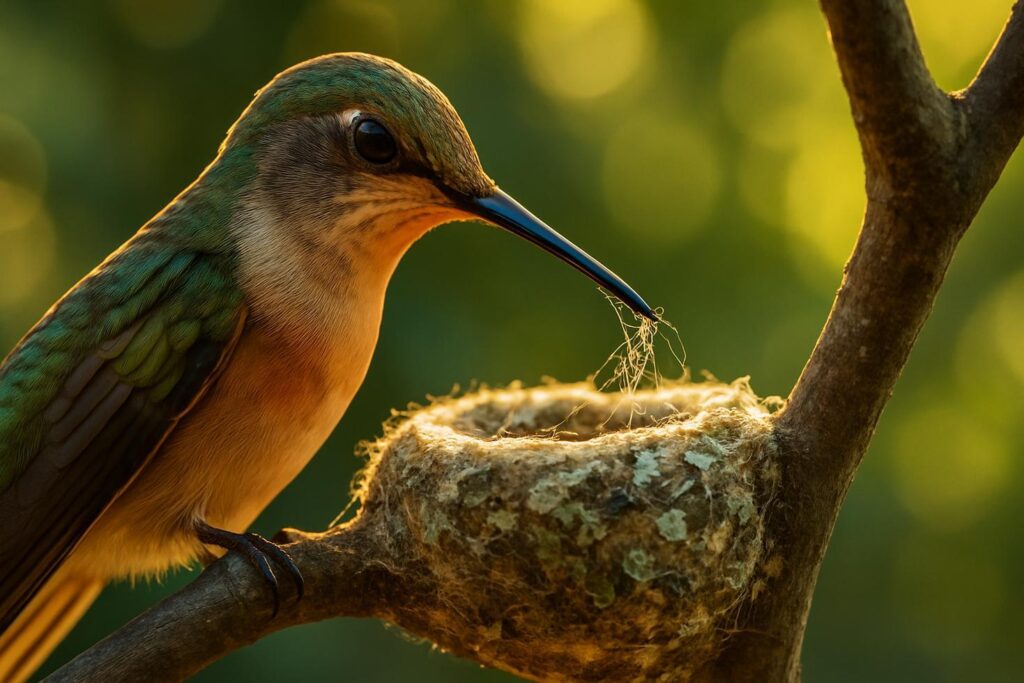
Spider dragline silk stretches up to 42% of its length at high humidity — and a hummingbird nest needs every bit of that give as chicks triple the space inside.
Female Ruby-throated hummingbirds wrap their nests in spider dragline silk so the structure can physically expand as chicks grow, accommodating double or triple the original interior space without tearing loose from the branch. It’s a construction strategy that relies on one of the most mechanically unusual fibers in nature. A bird weighing roughly 3 grams builds a nest that outlasts its own contents.
The silk does two jobs at once. It binds the soft plant fibers and moss together, and anchors the entire cup to the branch. Then, as chicks grow and press outward, the silk walls flex rather than split.
How the Female Ruby-Throated Hummingbird Collects and Places Spider Silk
The female uses her beak and breast to gather dragline silk — the load-bearing outer-frame thread from spider webs. She stretches it around both the nest walls and the supporting branch, effectively lashing the structure in place.
This isn’t a single layer. Multiple wraps distribute tension across the cup, so no single thread bears the full load when a chick shifts its weight. The redundancy matters: local breaks don’t unravel the whole nest.
Sticky sections of silk also catch lichen flakes pressed onto the exterior. Chicago Botanic Garden notes hummingbirds appear to select locally consistent lichen species, suggesting some preference in material choice beyond simple availability.
Why Spider Silk’s Humidity-Dependent Elasticity Matters Inside a Nest
Dragline silk from Nephila spiders has a breaking strain of about 18.9% at 25% relative humidity. At 85% relative humidity, that figure rises to 34.6%. The warm, damp microclimate inside an active nest pushes silk toward its more elastic end of that range.
The molecular mechanism involves proline-containing amino acid motifs in the silk protein’s amorphous regions. Higher hydration rearranges those regions, lowering the elastic modulus and allowing repeated stretch-and-recovery cycles without structural failure. The nest doesn’t just expand once — it flexes continuously as chicks move, shift, and grow over several weeks.
That combination of high tensile strength and genuine elastomeric recovery is what makes dragline silk useful here. Steel is stronger in tension but cannot recover from deformation. Spider silk does both.
What the Nest Must Survive Before Fledging
Young hummingbirds can require double or triple the nest space by the time they approach fledging. The silk-wrapped walls accommodate that increase by stretching outward, then partially recovering when weight shifts. BirdsConnect Sea notes the nests also withstand wind and rain throughout the nesting season, meaning the silk’s mechanical properties hold across weeks of variable conditions, not just a single growth event.
The nest stays anchored to the branch the entire time. When the chicks leave, the structure remains — a small cup of moss and lichen, still bound in silk, still holding its shape on the branch.
Spider silk didn’t evolve for this purpose. Hummingbirds found a material with exactly the right mechanical profile and built their reproductive strategy around it.
Frequently Asked Questions
Why do hummingbirds use spider silk instead of other fibers?
Spider dragline silk combines high tensile strength with humidity-responsive elasticity, allowing the nest to stretch as chicks grow while remaining anchored to the branch.
How much does spider silk actually stretch in a hummingbird nest?
Breaking strain ranges from roughly 13% to 42% depending on humidity; inside a warm, moist nest, conditions push silk toward the higher end of that range.
Do male hummingbirds help build the nest?
No. Female hummingbirds are the sole nest builders across hummingbird species.
Does the nest get reused?
The silk-wrapped structure remains on the branch after fledging, but verified sources here address construction and use during a single nesting season, not multi-season reuse.