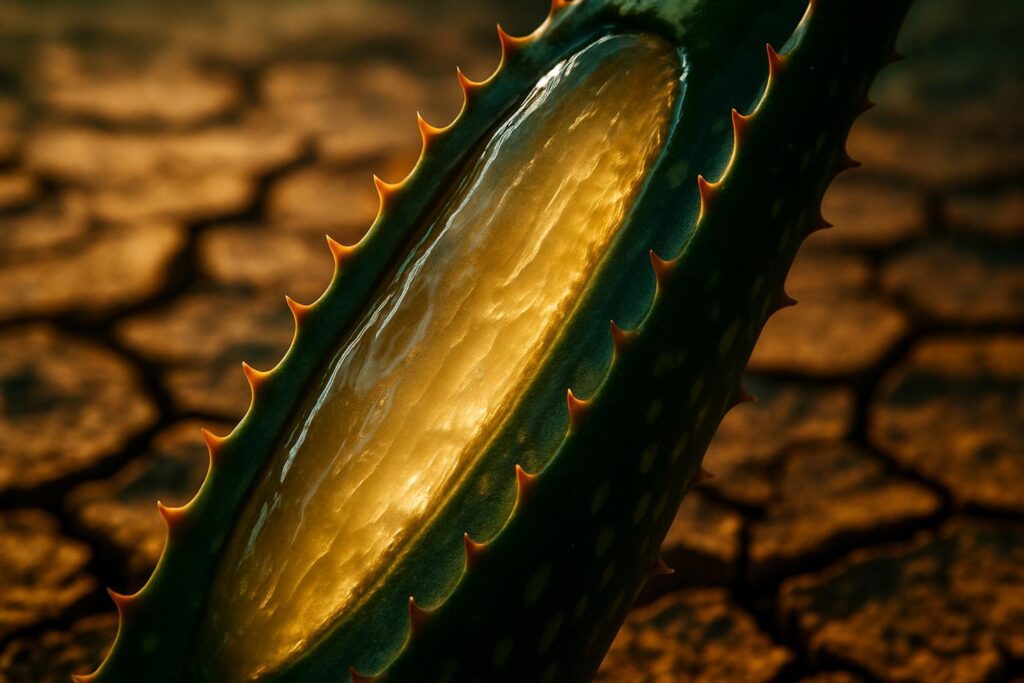
Between 75 and 200+ distinct compounds pack into one aloe leaf — split across two separate chemical layers that share almost none of the same molecules.
Aloe vera (Aloe barbadensis Miller) stores water, repels insects, and blocks UV radiation using a suite of 75 to 200+ biologically active compounds distributed across two structurally distinct leaf fractions. That is the short version. The longer version is stranger and more satisfying.
A single leaf holds two almost entirely different chemistry sets — a clear inner gel and a bitter yellow latex running just beneath the outer rind — and each one solves a different desert problem. Humans have been borrowing from both for more than 3,000 years. The plant never changed a thing.
How the Inner Gel Keeps Aloe Cells Alive Through Drought
The clear gel filling the leaf’s core is loaded with polysaccharides — primarily acemannan, a β-(1,4)-linked acetylated mannan. These molecules bind water at the molecular level, stabilizing fluid inside and around cells when rainfall disappears for extended periods.
The parenchyma tissue housing this gel is essentially water storage architecture under drought pressure. It is why an aloe leaf, severed from the plant, stays plump and moist long after a comparable leaf from a non-succulent would have shriveled.
What the Bitter Yellow Latex Does for the Plant
Just inside the outer rind sits the latex layer, a yellow fluid dense with anthraquinones and anthrones — most notably aloin and aloe-emodin. These compounds are powerfully bitter and act as laxatives and irritants in animals that ingest the leaf.
That bitterness is chemical herbivore deterrence, not accidental flavor. Any insect or grazing animal that damages the leaf encounters compounds that cause enough gastrointestinal disruption to discourage a return visit.
The Outer Cuticle’s Role as a Physical Barrier
The leaf’s exterior is sealed by a thick, waxy cuticle. This layer limits transpiration — water vapor escaping through the surface — and serves as a physical screen against intense desert UV radiation and desiccating wind.
Aloe vera also uses CAM photosynthesis to cut daytime water loss: stomata remain closed during the hottest daylight hours, opening only at night to take in CO₂. The cuticle and CAM metabolism work in parallel, and together they explain how the plant survives where annual rainfall is minimal.
Aloe vera’s chemical record stretches back more than 3,000 years in human use — ancient records from Egypt, including accounts linking the plant to figures like Nefertiti around 1353 BCE, suggest cosmetic and medicinal use well before that. Every application humans found mapped onto a mechanism the plant had already built for itself.
The desert did not produce a healing plant. It produced a survivor. The healing was a side effect.
Frequently Asked Questions
How many compounds are in an aloe vera leaf?
Reviews report roughly 75 potentially active compounds in the gel; more comprehensive phytochemical surveys counting polysaccharides and secondary metabolites separately reach figures exceeding 200 distinct identified chemicals.
Why is aloe latex bitter?
The latex contains phenolic anthraquinones — mainly aloin and aloe-emodin — that cause irritation and laxative effects in animals that eat the leaf, functioning as a chemical deterrent to herbivores.
How does aloe vera survive drought?
Water-binding polysaccharides in the inner gel retain cellular moisture during dry periods, the waxy outer cuticle limits evaporative water loss, and CAM photosynthesis keeps stomata closed during the day to reduce transpiration.
How long have humans used aloe vera?
Ancient records place aloe use in northeastern Africa and the Arabian Peninsula more than 4,000 years ago; accounts linking it to Nefertiti (ca. 1353 BCE) confirm cosmetic use at least 3,300 years ago.