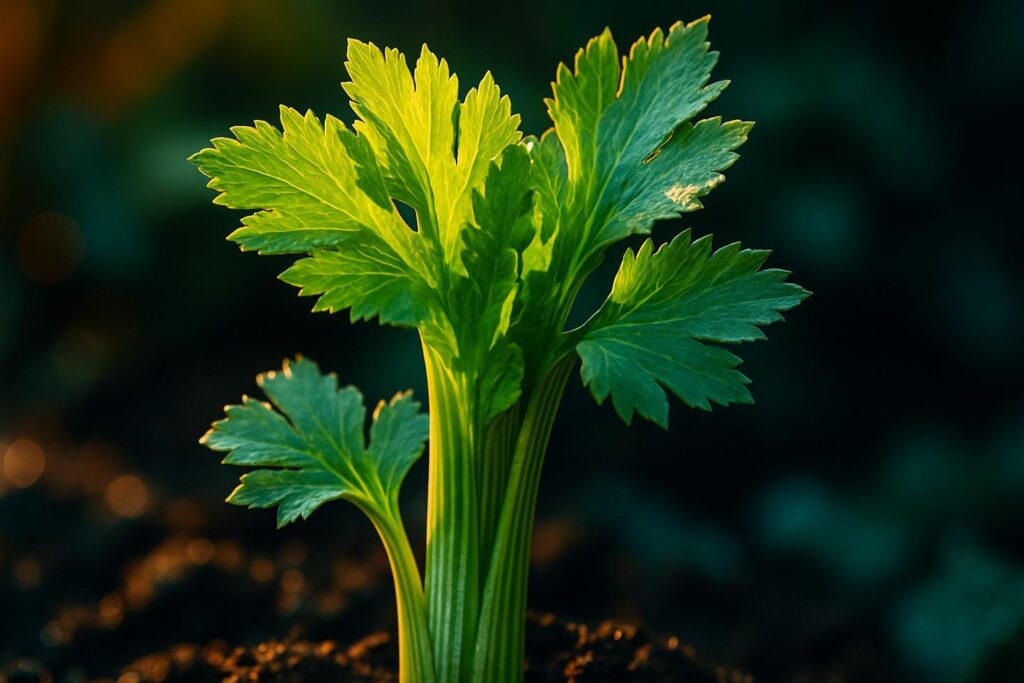
Celery leaves carry more calcium, potassium, and vitamin C than the stalks — the green tissue is where the plant concentrates what photosynthesis builds. Most kitchens throw that part away.
Celery leaves are more nutrient-dense than the stalks, with higher concentrations of calcium, potassium, and vitamin C per unit of weight. That fact sits quietly in the compost bin of most home kitchens. The stalk — crisp, mild, easy to slice — is what gets eaten. The leaves are what the plant actually spent energy making.
Photosynthesis happens in green tissue. Nutrients don’t travel far from where they’re produced, so the leaf is where they accumulate. The stalk is structural: mostly water and fiber, holding the plant upright. It’s scaffolding. The leaf is the chemistry.
Why Celery Leaves Concentrate More Nutrients Than Stalks
The mechanism isn’t mysterious. A plant’s leaf tissue is metabolically active — it’s where chlorophyll runs, where sugars are synthesized, where the cellular machinery operates. Vitamins and minerals that support those processes accumulate in that tissue. The stalk, by contrast, serves a different function: transport and support.
Photosynthetic tissue as a nutrient reservoir explains why the color of leaves signals something real. Deep green means dense chlorophyll. Dense chlorophyll means active cellular work. That activity draws and holds minerals like calcium and potassium, and produces vitamin C as a byproduct of metabolic function.
How Celery Leaves Are Actually Used in Professional Kitchens
Chefs have known this for a long time. Celery leaves appear in stocks, chimichurri, salads, and herb garnishes. The flavor is sharper and more concentrated than the stalk — a direct result of the same chemistry that makes the leaf nutritionally distinct.
Home cooks discard the leaves partly out of habit. Celery is sold and marketed by the stalk, so that’s what registers as the product. But the plant itself doesn’t rank its parts that way.
A Pattern That Extends Beyond Celery
Celery is not the only example. Carrot tops, beet greens, and radish leaves follow the same logic: photosynthetic tissue outperforms the marketed, structural part in nutrient density. The plant doesn’t hide the distinction — the color contrast between a pale stalk and a dark green leaf is itself a visible marker of where the metabolic work happens.
Most of what gets thrown away in a kitchen was the point all along.
Frequently Asked Questions
Are celery leaves safe to eat?
Yes. Celery leaves are fully edible and commonly used in cooking, particularly in stocks, salads, and herb-based sauces.
Which nutrients are higher in celery leaves than stalks?
Calcium, potassium, and vitamin C are all found in higher concentrations in celery leaves than in the stalks, according to Healthline citing comparative nutrition data.
Why do celery leaves taste stronger than the stalks?
The leaves are the site of active photosynthesis and metabolic production, which concentrates both flavor compounds and nutrients in that tissue.
Can celery leaves be used in cooking the same way as herbs?
Yes. Professional kitchens use them as a fresh herb — chopped into salads, added to stocks, or used as a garnish where a sharp, celery-forward flavor is wanted.