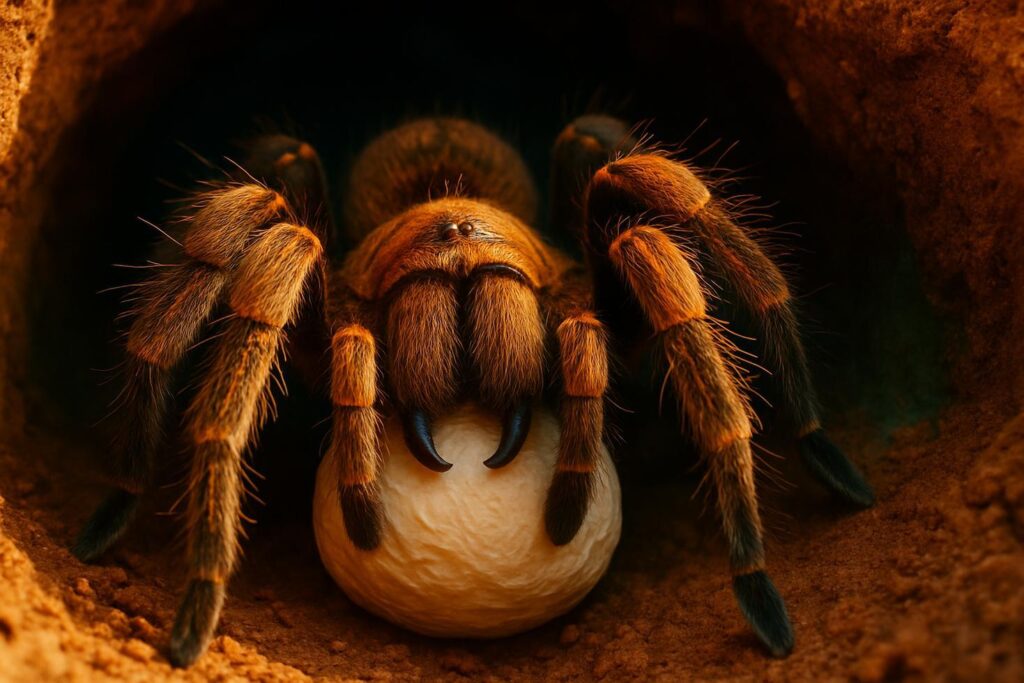
Some burrowing tarantulas — particularly Xenesthis species — cohabit with microhylid frogs whose skin chemicals the spider simply doesn’t register as prey. The frog eats egg-raiding ants. Neither animal chose the arrangement.
Some burrowing tarantulas do cohabit with small microhylid frogs, and the relationship benefits both animals. It sounds implausible — a spider that could easily consume a frog, choosing instead to share a burrow with one. But “choosing” isn’t quite the right word, and that distinction is the whole story.
The tarantula never decides anything. Its sensory system encounters the frog, processes the frog’s skin secretions, and returns no prey signal. The frog simply doesn’t register as food. What follows from that non-event turns out to be one of the more striking examples of mutualistic symbiosis documented in South American fauna.
How the Chemical Tolerance Between Tarantulas and Microhylid Frogs Works
The frogs most associated with this relationship — including Chiasmocleis ventrimaculata, documented with species in the Xenesthis genus — produce skin secretions that appear to make them chemically unpalatable or unrecognizable as prey.
This is not camouflage. It is not mimicry. Skin secretions bypass prey-recognition entirely, and the tarantula’s response is simply absence of attack. The frog gains something enormous from this: access to a defended burrow that almost nothing else its size could safely enter.
What the Frog Contributes to the Tarantula’s Burrow
The arrangement isn’t one-sided. Ant colonies represent a persistent threat to spider egg sacs — small, numerous, patient. A frog living inside or near the burrow consumes ants and other small arthropods before they can reach the eggs.
Ant predation by the frog protects spider eggs in a way the tarantula, for all its size, is not well-positioned to manage on its own. The frog handles a category of threat the spider can’t easily address.
Neither animal coordinates this. The tarantula doesn’t recognize a partner. The frog doesn’t understand a transaction. The mutual benefit emerges from two animals with overlapping needs, one of whom happens to be chemically invisible to the other.
Which Tarantula and Frog Species Are Involved
This relationship is not universal. It appears most reliably in South American burrowing tarantulas, with the Xenesthis genus among the most-cited. The microhylid family (Microhylidae) is the repeatedly named frog group across available sources, with Chiasmocleis ventrimaculata as a specific documented example.
Secondary sources also mention Cyclosternum fasciatum in connection with this kind of cohabitation. Most available documentation comes from naturalist observations and secondary reporting rather than controlled primary studies, so species-level details should be treated as the current best-available picture rather than settled science.
The core relationship — chemical tolerance enabling cohabitation, frog consuming ant threats near spider eggs — is the verified and consistent thread across sources.
The biology here didn’t require cooperation. It only required one animal to be invisible to another, and for that invisibility to leave room for something useful to happen.
Frequently Asked Questions
Do tarantulas keep frogs as pets?
No. “Pets” is anthropomorphic. The accurate description is mutualistic cohabitation — both animals benefit, but neither makes decisions about the other.
Why don’t tarantulas eat the microhylid frogs they live with?
The frogs produce skin secretions that appear chemically unrecognizable or unpalatable as prey, so the tarantula’s attack response isn’t triggered.
Which tarantula species share burrows with frogs?
South American burrowing tarantulas, particularly Xenesthis species, are the most-documented examples. Cyclosternum fasciatum also appears in accounts of this behavior.
What do the frogs eat inside the tarantula’s burrow?
The frogs consume ants and small arthropods that would otherwise threaten the spider’s egg sac.